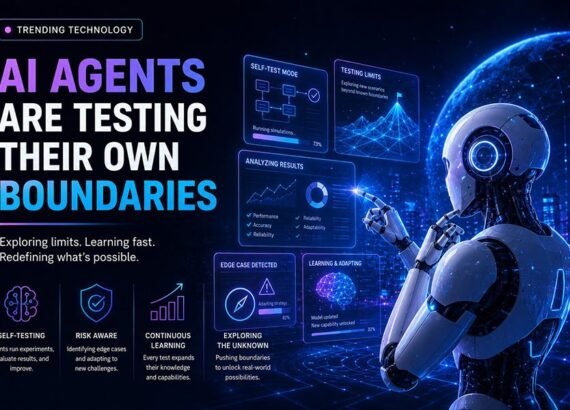
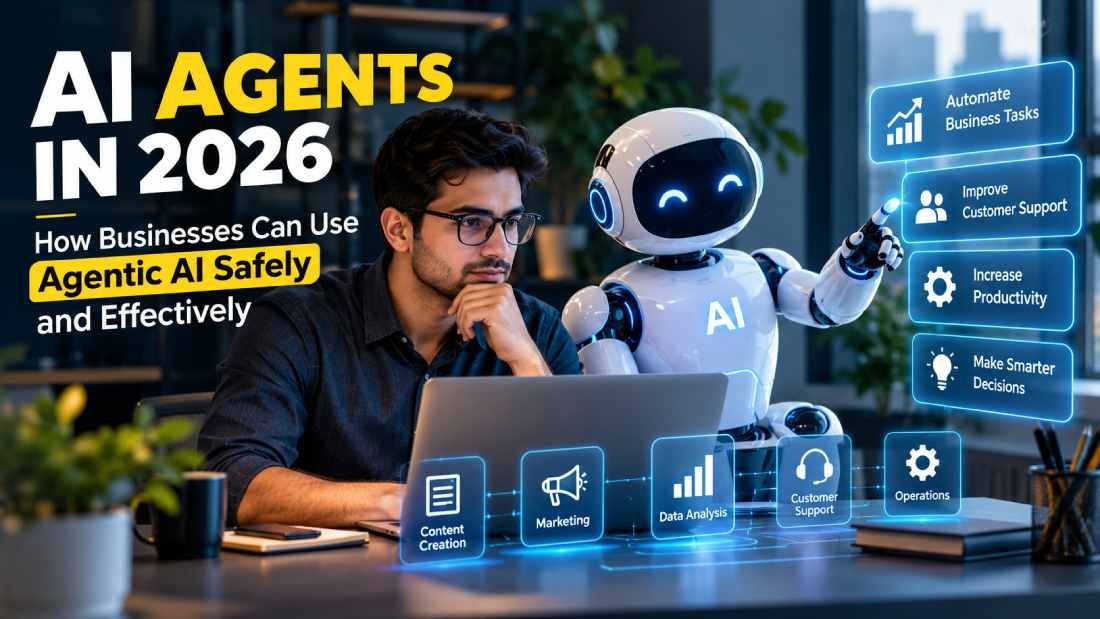
Artificial intelligence is moving into a new phase. Earlier AI tools mostly answered questions, generated text or summarised information when a person asked. AI agents are designed to go further: they can work toward a goal, plan a sequence of steps, use approved tools and systems, and return a completed result with less step-by-step direction from a human.
This shift is becoming a major technology story in 2026. On October 8, Google Cloud announced its Gemini agent for workplace tasks, describing an assistant that can connect with business systems and work across knowledge tasks, content creation and coding. OpenAI also introduced its Agents API in September, giving developers infrastructure for building agents that use tools and coordinate work. These announcements point to a broader direction: companies want AI that can help finish workflows, not only respond to prompts.
For business owners, the opportunity is real, but so is the need for careful planning. The best approach is not to automate everything at once. It is to identify a repetitive, measurable task, test an agent within clear boundaries, and check whether it delivers dependable value.
What Are AI Agents?
An AI agent is a software system that uses an AI model to pursue a defined objective. Depending on its design, it may break a task into smaller steps, retrieve information, call approved tools, check results and decide what to do next. A customer-support agent, for example, might look up an order, check a delivery policy, draft a reply and ask a staff member to approve it before sending.
Agents also differ in their level of autonomy. A low-risk agent might prepare a report for review. A more autonomous one might update records or trigger a workflow. Actions that affect money, legal commitments, customer access or sensitive data should require stronger checks and, where appropriate, human approval.
Why AI Agents Are a Major Technology Trend in 2026
Recent industry announcements show growing interest in agents that work across existing business software. Google Cloud’s October 2026 announcement emphasised a universal work agent with connections to workplace tools, business context, skills and governance controls. OpenAI’s September 2026 Agents API announcement focused on helping developers run long-running agents, use tools and delegate parts of a complex task to subagents. These are vendor announcements, not proof that every organisation will benefit equally, but they illustrate the direction of product development.
However, adoption is not the same as guaranteed return on investment. Results depend on the quality of company data, how well the workflow is defined, the cost of using the system, integration effort and the consequences of mistakes. A focused pilot with clear success measures is more useful than adopting a tool simply because it is trending.
Practical Uses of AI Agents for Businesses
1. Customer support: An agent can search approved help articles, summarise a customer’s issue, classify a request and prepare a response. If connected to order systems, it may retrieve status details. Start with recommendations and drafts, then consider limited automation after measuring accuracy and escalation rates.
2. Marketing and content operations: Agents can help organise research, produce outlines, repurpose approved material, draft social captions and create campaign checklists. Human editors should verify facts, originality, brand voice and search intent. Publishing AI-generated content without meaningful review can introduce errors and produce pages that offer little value to readers.
3. Sales administration: Agents may summarise customer relationship management notes, prepare meeting briefs, draft follow-up emails and identify missing information in a lead record. Keep a person responsible for claims, pricing, negotiation and any message that commits to a customer.
4. Internal knowledge search: Employees often lose time locating policies, project documents or product information. An agent connected to permission-controlled sources can summarise relevant material and point users to the original documents. Access permissions must carry through to the agent, so it does not reveal information a person could not otherwise view.
5. Software development and IT operations: Developer agents can help explain code, suggest changes, write tests or investigate routine issues. Changes should be reviewed, tested and logged. Production access needs particular care because a mistaken action can affect services, data or customers.
6. Reporting and operations: An agent may collect data from approved sources, draft a weekly summary, flag unusual movements and list questions for a manager. The output should show where figures came from and distinguish verified data from interpretation. A human should validate important numbers before decisions are made.

How Small Businesses Can Get Started
Small businesses do not need to build a complex multi-agent system to benefit from AI. Start with one workflow that is frequent, time-consuming and relatively low risk. Examples include preparing meeting notes, sorting incoming enquiries, drafting responses to common questions or assembling a weekly performance summary.
Step 1: Map the workflow. Write down the trigger, inputs, steps, systems involved, expected output and common exceptions. If the process is unclear to the team, it will be difficult to automate reliably.
Step 2: Choose a measurable goal. Record a baseline before the pilot. Useful measures include minutes spent per task, response time, error rate, number of cases escalated and cost per completed task. Avoid relying on a vague goal such as “use more AI.”
Step 3: Use approved data and tools. Check what information the system can access, where it is processed, how long it is retained and whether the provider’s terms fit your business obligations. Do not upload confidential customer or employee information to an unapproved service.
Step 4: Keep the first version supervised. Let the agent recommend actions or create drafts while a person reviews the output. Collect examples of failures, update instructions and test edge cases before expanding its authority.
Step 5: Review the results. Compare the pilot against the baseline. Include the time needed for checking and correcting outputs, integration costs and subscription or usage fees. If the agent does not improve the workflow, revise it or stop the pilot.
Security, Privacy and Governance: What to Watch
The more an agent can do, the more important its permissions become. Gartner warned in September 2026 that employees may create or use AI agents outside formal oversight, producing “shadow AI” that security teams cannot easily inventory or control. Microsoft’s October 2026 security guidance likewise highlighted the need to identify agents, assign distinct identities and limit their access. These concerns are not reasons to avoid agents; they are reasons to design them responsibly.
Apply least privilege. Give an agent access only to the systems and data it needs for the approved task. Avoid sharing a broad employee login or giving an agent administrator rights by default. Use separate identities, scoped permissions and time-limited access where supported.
Require approval for consequential actions. Payments, refunds above a set amount, deleting records, changing permissions, sending sensitive messages and publishing to production should have clear approval rules. The more difficult an action is to reverse, the stronger the review should be.
Defend against misleading instructions. Agents may encounter malicious or irrelevant instructions inside emails, documents, web pages or other retrieved content. Treat external content as data, not as authority to override system rules. Limit tool access, validate inputs and test how the agent behaves when it encounters suspicious instructions.
Protect personal and business data. Review retention, training use, data residency, encryption, access logging and deletion terms. Follow applicable privacy and industry requirements. Do not assume that a provider’s default settings match your obligations.
Monitor and keep records. Log important tool calls, data access, approvals, failures and changes. Assign a business owner to each agent, review its performance regularly and provide a way to pause or disable it. Test again when models, prompts, integrations or permissions change.
Costs and Return on Investment
Agent costs are broader than the subscription price. Consider model usage, connected software, integration work, monitoring, employee training, security controls and the time people spend reviewing outputs. Some tasks may become cheaper, while others may cost more because they require frequent verification or fail on unusual cases.
A simple business calculation is to compare the value of time saved and errors avoided against the full operating cost. For example, estimate how many hours a workflow takes each month before automation, how many hours remain afterwards, and the loaded cost of that time. Then subtract tool, integration and review costs. Use actual pilot data rather than vendor claims or best-case demonstrations.
What the Future May Look Like
AI agents are likely to become more integrated into business applications, with more specialised tools for research, software development, customer service and analytics. Multi-agent designs may divide a larger task among specialised components, while a coordinating system combines the results. Better evaluation, identity management and permission controls will be essential if these systems are to be trusted with important work.
The practical advantage will come from combining capable technology with good processes and accountable people. Businesses that understand their workflows, protect their data and measure results will be better positioned to use AI agents where they genuinely help.
Conclusion
AI agents are an important technology trend in 2026 because they aim to move AI from answering questions toward completing multi-step work. They can support customer service, marketing, sales administration, internal knowledge search, software development and reporting. For small businesses, the sensible route is to start with one low-risk workflow, define success, supervise the agent and expand only when evidence supports it.
Security must be part of the design from day one. Keep permissions narrow, protect sensitive information, log activity and require human approval for consequential actions. AI agents will not automatically make every business faster or more profitable. Used thoughtfully and evaluated honestly, however, they can reduce repetitive work and give teams more time for customer relationships, strategy and creative problem-solving.
Frequently Asked Questions
1. What are AI agents in simple terms?
AI agents are software systems that can work toward a goal by planning steps, using approved tools and completing parts of a workflow. Their capabilities and autonomy vary by product.
2. How are AI agents different from chatbots?
A chatbot mainly responds to messages. An agent may also use connected systems and take a sequence of actions to complete a task. Some products combine both approaches.
3. Can small businesses use AI agents?
Yes. Small businesses can begin with tasks such as drafting customer replies, organising enquiries, preparing reports or creating checklists. Start with a supervised, low-risk workflow and measure results.
4. Are AI agents safe for business use?
They can be useful when deployed with appropriate safeguards, but they can make mistakes or be manipulated. Limit permissions, protect data, monitor activity and require approval for high-impact actions.
5. Will AI agents replace employees?
The impact depends on the job and how the technology is used. Agents can automate parts of some tasks, while people remain important for judgment, relationship management, accountability and handling unusual situations. Businesses should assess task-level changes rather than assume a single outcome for every role.
6. How can a company measure an AI agent’s value?
Compare performance with a baseline using time saved, quality, error rates, customer outcomes, escalation rates and total cost. Include the human effort required to review and correct the agent’s work.
7. What is the biggest risk of using AI agents?
There is no single risk for every use case. Common concerns include excessive access, data exposure, incorrect actions, misleading instructions and limited oversight. The level of control should match the potential impact of a mistake.
8. What is the best first AI agent project?
Choose a frequent task with clear inputs and outputs, low consequences if something goes wrong, and results that are easy to check. A supervised report draft or customer enquiry classification pilot is often more suitable than giving an agent broad control over live systems.
Thank you for reading
Buy Latest Tech Gadgets and Laptops: Click Here
Buy Web Hosting at an affordable price: Buy Now.
If you want to build your website at an affordable price, contact www.nextrtechnology.com
If you want to build your website at an affordable price, contact www.nextrtechnology.com
Read more blogs: https://nextrtechnology.com/blog/