Artificial Intelligence is moving into a new stage. Smart systems are no longer just answering questions or doing one task at a time. Businesses are starting to look at AI agents that can grasp goals, make choices, use digital tools and work with other smart systems. This shift is putting Multi-Agent Orchestration in the spotlight as one of the exciting steps in AI tech for 2027. Instead of leaning on one AI model to handle everything, companies can set up several focused AI agents that team up to finish complex business work.
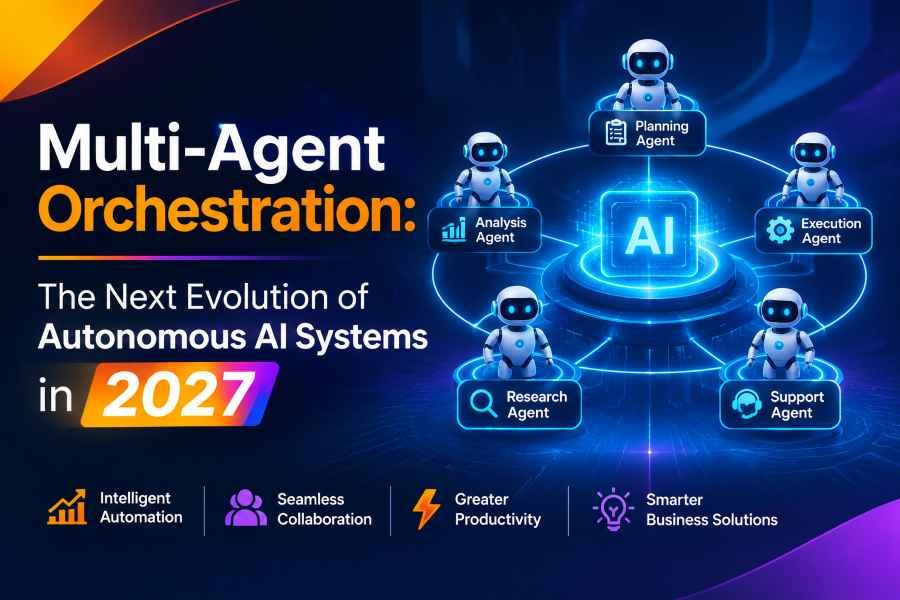
Multi-agent orchestration means coordinating autonomous AI agents through a structured system. That system handles communication, task sharing, decision-making and workflow execution. Each agent does a job while working with other agents to reach a shared goal. Take a store, for example. It can use AI agents for customer support, stock management, product suggestions, order processing and sales analysis. These agents swap information. Sync their actions, which creates a smarter and more connected business setup.
As organisations bring in AI-powered automation, multi-agent systems are likely to matter more and more for boosting output, cutting down work and building smarter digital tools. In 2027, multi-agent orchestration could become a part of enterprise software development, intelligent automation and next-generation business apps.
Understanding How Multi-Agent Orchestration Works
Multi-agent orchestration brings focused AI agents together into one coordinated ecosystem. Each agent gets instructions, processes information and does tasks based on its role. An orchestration layer manages how these agents interact. It decides which agent should handle an activity and makes sure the whole workflow stays organised.
Say a business gets a customer question. A customer support agent can figure out the request. A data retrieval agent can pull customer details. A problem-solving agent can find a solution. Another agent can draft the reply, while a monitoring system checks if the task was completed properly. This team approach lets organisations handle workflows without relying fully on manual coordination.
Different orchestration setups fit business needs. Centralised orchestration uses one controller to assign tasks and watch agent activity. Decentralised orchestration lets agents talk and coordinate with each other without a controlling agent. Hierarchical orchestration blends both by putting agents into levels of responsibility. Businesses can pick a setup based on how complex their operations are, their security needs, and how much they need to scale.
Modern AI development frameworks and communication protocols are also making multi-agent collaboration more practical. Tools such as LangGraph, CrewAI and Microsoft’s AutoGen give developers what they need to build AI workflows. Protocols such as Model Context Protocol (MCP) and Agent2Agent (A2A) support links between agents, tools and outside systems.
Still, good orchestration takes more than linking several AI models. Developers must set agent roles, structured communication, reliable data access, workflow monitoring and error-handling steps. These pieces help make sure autonomous AI systems run steadily and deliver business results.
Key Benefits and Business Applications of Multi-Agent AI Systems in 2027
Agent orchestration gives businesses several chances to improve their digital operations. One of its strengths is smart task sharing. Instead of giving every activity to one AI model, organisations can break complex operations into smaller tasks and spread them among focused agents. This can boost workflow efficiency. This lets different processes run at the same time.
Another key plus is business automation. Multi-agent AI systems can coordinate activities across departments. That includes customer relationship management, data processing, reporting, sales operations and internal support. By cutting steps, businesses can free up employees to focus on strategic planning, creativity and customer relationships.
Scalability is another benefit. Organisations can add AI agents as their needs grow without rebuilding every existing workflow. For example, a growing online business can add agents for marketing analysis, customer engagement, payment monitoring and order management. This flexibility makes agent orchestration useful for startups, growing companies and large enterprises.
In customer service, several agents can work together to understand what customers need, pull information, suggest solutions and manage support requests. In software development, focused agents can help with requirement analysis, code generation, debugging, documentation and software testing. In marketing, agents can study market trends, research keywords, judge campaign performance and create content suggestions.
Multi-agent systems can also improve business intelligence by pulling together information from sources. Data analysis agents can spot patterns. Reporting agents can organise findings. Recommendation agents can help decision-makers see opportunities. In e-commerce, coordinated agents can support stock forecasting, personalised shopping experiences, customer communication and order tracking.
With these upsides, organisations must tackle key challenges before deploying autonomous AI systems at scale. Security, data privacy, communication failures, inaccurate outputs, operating costs and uncontrolled agent behaviour all need attention. Human oversight is still vital for activities and important business decisions. Companies should put in place permission controls, activity monitoring, testing steps and clear accountability to keep AI operations reliable.
The Future of Multi-Agent Orchestration and Autonomous AI Development
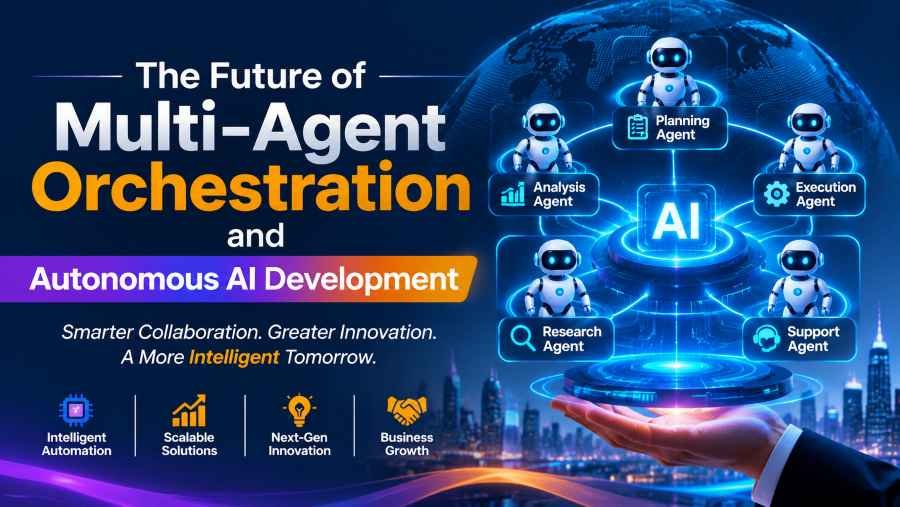
The future of multi-agent orchestration will centre on building smarter, more connected, safer and more adaptable AI ecosystems. In 2027, businesses are likely to explore systems where focused agents can work together across software platforms, grasp changing requirements and coordinate tricky workflows with more independence. AI reasoning, agent communication protocols, context management and workflow automation will drive this shift.
Another rising direction is enterprise AI orchestration. Instead of rolling out separate AI tools for each department, organisations can build connected systems that coordinate operations across sales, marketing, customer service, finance and technology. Such systems can improve information sharing. Create more consistent digital workflows.
AI agent interoperability will also matter more and more. Businesses may use agents built with frameworks, models and platforms. Standardised communication methods can help these systems swap information. Collaborate better. At the same time, AI governance will become a key part of development. It makes sure agents follow defined permission policies and security requirements.
For tech companies, this shift creates opportunities in custom software development, AI application development, enterprise automation and intelligent digital infrastructure. Building multi-agent solutions takes know-how in software architecture, API integration, cloud infrastructure, data management and AI engineering.
Nextr Technology sees the growing value of software solutions and modern digital innovation. By focusing on software development, custom web development, mobile application development and digital transformation, businesses can build the tech foundation they need to explore emerging AI capabilities.
Organisations that get their digital infrastructure ready today will be in a spot to adopt autonomous AI systems as the tech matures. Multi-agent orchestration is not about making single AI agents smarter. It is about letting multiple smart systems work together toward business goals.
Conclusion
Multi-Agent Orchestration marks a step in the evolution of autonomous AI systems. By linking focused AI agents through coordinated workflows, businesses can improve automation, smooth out operations, boost productivity and build digital experiences. As AI tech advances in 2027, multi-agent systems will open possibilities for enterprise automation, software development, customer service and business intelligence. Companies that invest in software architecture, secure integrations and responsible AI development can build a strong base for the next generation of intelligent business solutions.
Frequently Asked Questions (FAQs)
1. What is Multi-Agent Orchestration in Artificial Intelligence?
Multi-Agent Orchestration is the process of coordinating autonomous AI agents so they can communicate, share tasks, swap information and work together to complete complex goals. It helps businesses build workflows and automate different operations.
2. How Do Multi-Agent AI Systems Work?
Multi-agent AI systems work by giving roles to different AI agents. An orchestration layer manages communication, task allocation, workflow execution and performance monitoring to make sure agents work together toward a goal.
3. What Are the Main Benefits of Multi-Agent Orchestration for Businesses?
The main benefits include workflow automation, improved task sharing, higher operational efficiency, scalability, less repetitive work and stronger decision-making. Businesses can also use agents to coordinate activities across different departments.
4. Which Technologies Are Used to Build Multi-Agent AI Systems?
Developers use tools and frameworks such as LangGraph, CrewAI, Microsoft AutoGen and OpenAI Agents SDK to build agent applications. Communication technologies such as MCP and A2A can also support integration between AI agents and outside tools.
5. What Is the Future of Multi-Agent Orchestration in 2027?
In 2027, multi-agent orchestration is expected to grow in importance for enterprise automation, intelligent software development, customer support and business operations. Greater interoperability, AI reasoning, stronger security and human-supervised autonomy will shape its development.
Thank you for reading
Buy Latest Tech Gadgets and Laptops: Click Here
Buy Web Hosting at an affordable price: Buy Now.
If you want to build your website at an affordable price, contact www.nextrtechnology.com
If you want to build your website at an affordable price, contact www.nextrtechnology.com
Read more blogs: https://nextrtechnology.com/blog/