
Starship Reached Orbit. SpaceX Wants to Catch the Whole Rocket: What Flight 15 Means for Spaceflight
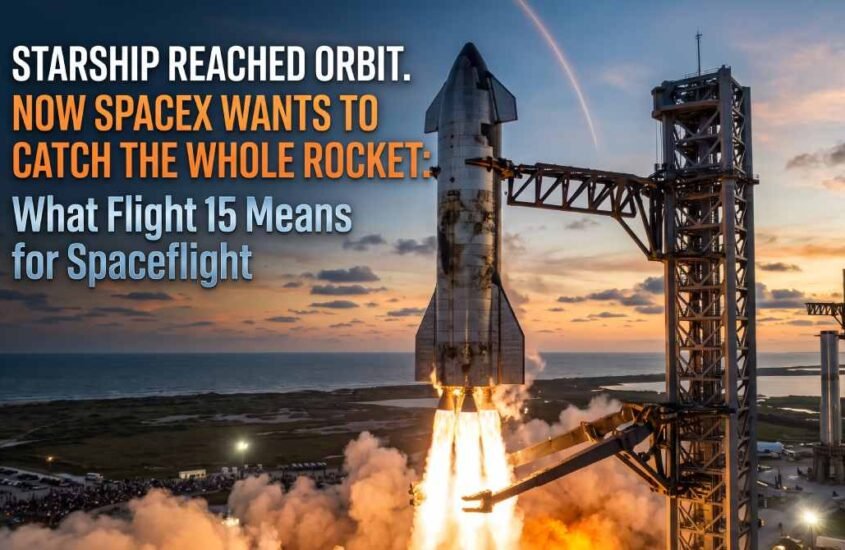
On September 28, 2026, SpaceX did something it had failed to do across thirteen earlier attempts: it put Starship, the largest rocket ever built, into orbit around Earth. Less than a month later, the company has set an even bolder goal for what comes next. On its third-quarter earnings call on October 20, SpaceX said Starship Flight 15, expected in November, will try to catch both the Super Heavy booster and the Starship upper stage with the launch tower’s mechanical arms, something no company has ever done with an orbital-class rocket.
If it works, it would be the first full recovery of an orbital launch system. If it doesn’t, SpaceX has already warned that it will keep trying. Either way, the stakes reach well beyond one test flight: Starship underpins the next generation of Starlink satellites, NASA’s plans to return astronauts to the Moon, and the business case for a company that now answers to public shareholders. Here’s what happened on Flight 14, what Flight 15 is attempting, and what to watch for.
Quick facts
- Starship Flight 14 launched on September 28, 2026, and reached orbit for the first time after 13 suborbital test flights.
- The ship deployed 26 Starlink V3 satellites, Starship’s first operational payload.
- Flight 15 is expected in November, reportedly no earlier than November 8, and will attempt to catch both the booster and the ship.
- SpaceX reported Q3 2026 revenue of $14.6 billion, up 161% from a year earlier.
- A ship-to-ship propellant transfer test, essential for NASA’s lunar plans, is now planned for early 2027.
Flight 14: The Orbital Milestone
Starship lifted off from Starbase in South Texas on the morning of September 28 for its 14th integrated test flight, and the first designed to reach orbit. All 13 previous flights were deliberately suborbital, a precaution so that a failed vehicle would fall back to Earth in a safe area. This time, the goal was to reach orbital speed, roughly 17,500 miles per hour, at an altitude of about 275 kilometres (171 miles).
It was not a perfectly smooth ride. About two and a half minutes after liftoff, the ship separated from the Super Heavy booster, and during ascent one of the ship’s six engines failed. Mission managers had to decide whether it was still safe to attempt orbit, since the burn that sends the ship into orbit is only allowed if flight controllers are confident the vehicle can also bring itself home. Around 22 minutes into the flight, they gave the go-ahead, and Starship made it.
Once in orbit, the ship deployed 26 Starlink V3 satellites, the first time Starship carried an operational payload rather than a test article. Each V3 satellite is designed to add roughly one terabit per second of capacity to the Starlink network. Three of the satellites carried cameras to capture imagery of the ship’s heat shield, and the flight was also the first to reuse heat-shield tiles, both important steps toward making the vehicle reusable.
SpaceX had planned a flight of around ten hours with six orbits, but mission managers shortened it to about three hours, and the ship made a controlled splashdown in the Pacific Ocean. An early finish isn’t a failure: reaching orbit and delivering working satellites were the main objectives.
Flight 15: Trying to Catch Both Stages
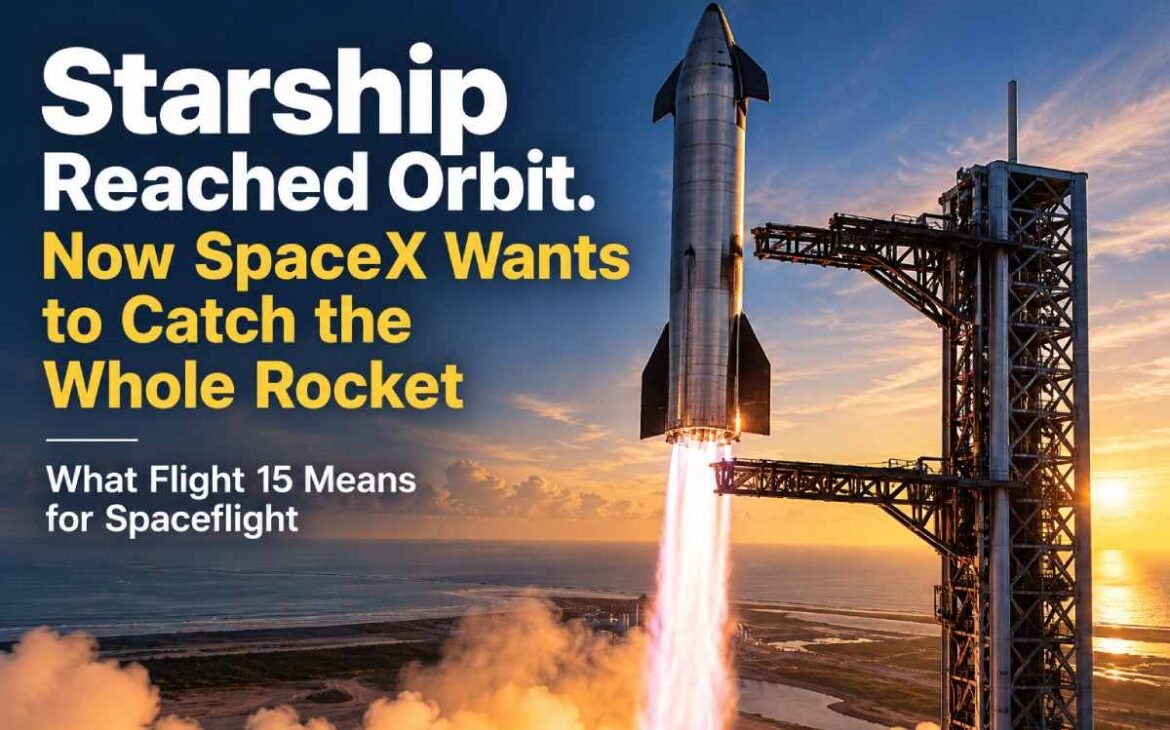
SpaceX has been catching its Super Heavy boosters with the launch tower’s “chopstick” arms since October 2024, and reports indicate it has done so three times. The upper stage is a different story. Every Starship so far has ended its flight in the ocean, because a ship returning from orbit is moving much faster than a booster returning from the edge of space, which makes a precise catch far harder.
On the earnings call, SpaceX showed a simulation of the plan: the ship falls belly-first through the atmosphere, flips upright with a short engine burn, and settles between the tower’s arms. Reports of the call say Flight 15 is targeted for no earlier than November 8, though SpaceX hasn’t officially announced a launch date. On October 25, the company ran a full-duration static fire of all 33 engines on the Flight 15 booster, one of the final checkpoints before launch.
Regulation is the other hurdle. Returning both stages to the launch site means flying back over land, including part of northern Mexico. SpaceX President Gwynne Shotwell said the company has had constructive engagement with the FAA and expects the Flight 15 license to cover a return to the launch site and a tower catch for both stages, but based on reporting from the call, that license had not yet been issued. Elon Musk also tempered expectations, saying a successful catch on the first attempt is not guaranteed.
Why Catching a Rocket Matters
Catching a rocket on the tower, rather than landing it on legs, is a means to an end: fast, cheap reuse. Starship is designed to be fully reusable, and the economics of the whole program depend on flying the same hardware again and again, much as airlines fly the same aircraft many times a day.
SpaceX is already thinking about what comes after a successful catch. Shotwell said that after Flight 15, the company will try to fly a Starship upper stage a second time early next year, and it expects to reach a much faster launch cadence in early 2027, with the aim of flying as often as weekly. That is an ambitious target for a vehicle that has flown 14 times in three years, and it should be read as a goal rather than a forecast. SpaceX also said it will mostly carry its own cargo on Starship in 2027, which in practice means more Starlink satellites.
The Business Behind the Rocket
These test flights now play out in front of public investors. SpaceX went public in June 2026 and trades on Nasdaq under the ticker SPCX, so its third-quarter report on October 20 was closely watched. The company reported revenue of $14.6 billion, up 161% from $5.6 billion a year earlier, and reports on the call indicate a net profit of about $4.4 billion compared with a loss in the same quarter of 2025.
Starlink remains a core engine. Connectivity revenue rose 69% to $5.2 billion, with subscribers reaching about 13.6 million. SpaceX also highlighted a fast-growing AI-focused segment, which it calls Super Intelligence, that generated $7.6 billion in revenue during the quarter. Capital spending hit $19.6 billion in the quarter, driven by AI compute buildout, Starship infrastructure, and satellite production, and SpaceX guided to first-quarter 2027 revenue of $33 to $37 billion.
The Moon Depends on Refuelling
Starship is also central to NASA’s plans to return astronauts to the lunar surface. The agency selected SpaceX to develop a modified Starship as a human landing system, with a crewed landing on Artemis 4 possible as early as 2028. Reaching orbit was a necessary step, but the hardest milestone is still ahead: transferring cryogenic propellant from one Starship to another in orbit, so that a lunar-bound ship can top off its tanks before leaving Earth.
That long-delayed demonstration is now planned for early 2027, according to Shotwell. Until it succeeds, the lunar timeline remains uncertain. The catch attempt tests recovery and reuse; the propellant transfer tests whether Starship can do the job NASA is paying it for.
What Could Still Go Wrong
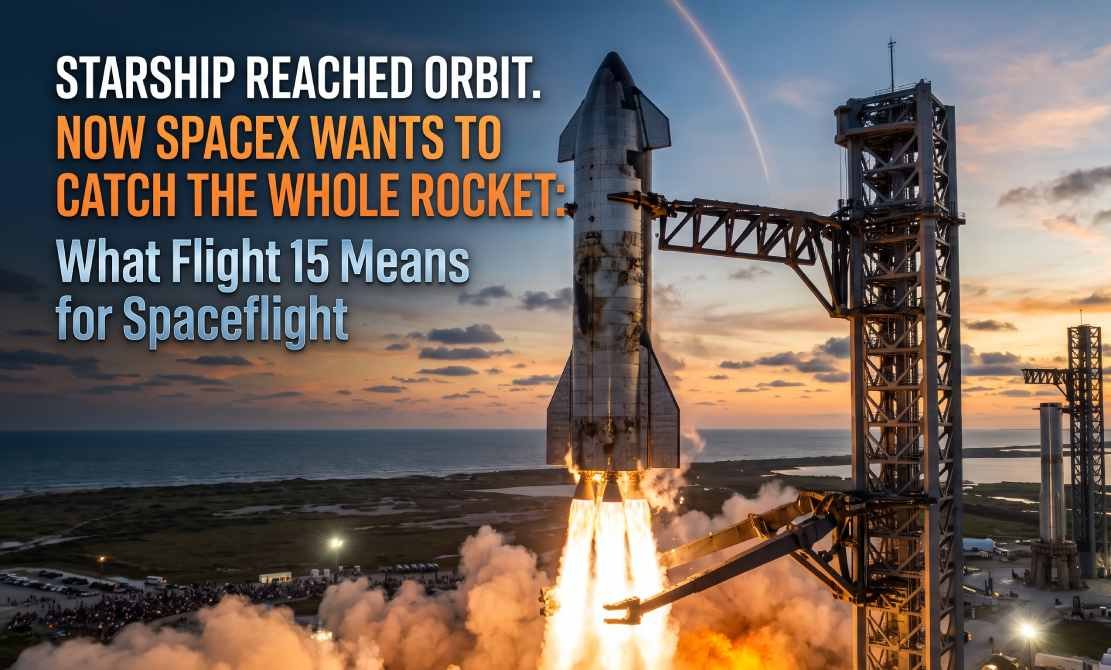
Starship’s history is a reminder that schedules slip and hardware surprises. Flight 14 itself lost a ship engine during ascent, and on Flight 13 ice clogged three centre engines on the booster during a manoeuvre that used all 33 engines for the first time. Each issue was manageable, but they show how much is still being learned about the Raptor engines and the vehicle’s systems.
The Flight 15 plan layers new risk on top of those. An upper-stage catch has never been attempted, the flight path includes an overland return that regulators must approve, and the FAA license isn’t final. Treat the November date as a target, not a promise.
Conclusion
In one month, Starship has gone from never having reached orbit to carrying operational satellites and preparing for what could be the first full recovery of an orbital launch system. The progress is real, and it’s backed by a company now generating billions in quarterly revenue and spending heavily to scale Starship production and launch infrastructure.
But the next few milestones are the ones that matter most: a successful double catch, a second flight of the same ship, and an in-orbit propellant transfer. If SpaceX delivers them in the coming months, Starship moves from impressive test vehicle to working infrastructure for Starlink, NASA, and commercial customers. If not, expect delays, more tests, and an even closer look from regulators and investors. Either way, Flight 15 is the next big moment to watch.
Frequently Asked Questions
When is Starship Flight 15?
SpaceX has said it expects Flight 15 in November 2026, and reports of the earnings call put the earliest date at November 8. SpaceX has not officially announced a launch date, and the FAA license covering the return and catch of both stages had not been issued at the time of reporting.
What happened on Starship Flight 14?
On September 28, 2026, Starship reached orbit for the first time and deployed 26 Starlink V3 satellites. One of the ship’s six engines failed during ascent, but mission managers decided it was safe to continue. SpaceX then shortened the planned ten-hour flight to about three hours, and the ship splashed down in the Pacific Ocean.
What is the Flight 15 “double catch”?
SpaceX plans to catch both the Super Heavy booster and the Starship upper stage using the mechanical arms of its launch tower at Starbase, Texas. Boosters have been caught before, but an upper-stage catch has never been attempted, so a successful double catch would be the first full recovery of an orbital launch system.
Why is catching the ship harder than catching the booster?
The ship returns from orbit at much higher speed than the booster, which only travels to the edge of space before coming back. That means the ship must survive a more intense re-entry and then guide itself to a precise stop between the tower’s arms.
Is SpaceX a publicly traded company?
Yes. SpaceX went public in June 2026 and trades on Nasdaq under the ticker SPCX. It reported its third-quarter 2026 results on October 20, with revenue of $14.6 billion, up 161% year over year.
How does Starship connect to NASA’s Moon plans?
NASA selected SpaceX to develop a modified Starship as a human landing system for the Artemis program, with a crewed landing on Artemis 4 possible as early as 2028. Before that can happen, SpaceX must prove it can transfer propellant between two Starships in orbit, a test now planned for early 2027.
After a first-ever orbital flight on September 28, SpaceX says Flight 15 will try to catch both the booster and the ship with the launch tower. Here’s what happened, what’s planned, and what it could mean for Starlink, the Moon, and SpaceX’s newly public business.
Thank you for reading
Buy Latest Tech Gadgets and Laptops: Click Here
Buy Web Hosting at an affordable price: Buy Now.
If you want to build your website at an affordable price, contact www.nextrtechnology.com
If you want to build your website at an affordable price, contact www.nextrtechnology.com
Read more blogs: https://nextrtechnology.com/blog/