SEO Errors That Are Hurting Your Website Rankings
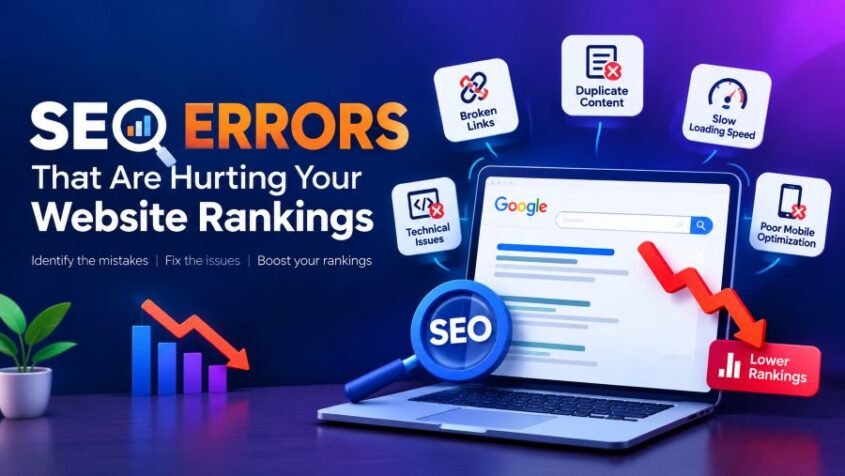
Search engine optimisation is no longer about adding keywords to a webpage and waiting for Google to rank it. In 2026, successful SEO depends on a combination of content, technical accessibility, search intent, user experience, mobile usability, website performance and a trustworthy online presence. Google itself recommends creating helpful, reliable, people-focused content rather than content designed primarily to manipulate rankings.
Many businesses invest in SEO. Still struggle to gain organic visibility because small or repeated mistakes are holding their websites back. From keyword stuffing and duplicate content to slow pages, internal linking, indexing problems and weak mobile experiences, these issues can reduce your website’s ability to perform effectively in Google Search.
If your traffic has dropped, your pages are not indexing, or your keywords are stuck on the third page, it may be time to identify and fix the SEO errors affecting your website.
Common On-Page SEO Errors That Can Hurt Rankings
On-page SEO helps search engines understand what a webpage is about while making the content useful for visitors. However, many websites still follow SEO practices that can negatively affect their visibility.
Keyword Stuffing and Poor Keyword Targeting
One of the common SEO errors is using the same keyword excessively. For example, repeating a phrase such as “SEO company in Delhi” unnaturally throughout every paragraph can make content difficult to read. May be considered keyword stuffing.
Instead, focus on the search intent behind the target keyword. Use the keyword naturally in the title, introduction, headings, URL, and relevant sections where appropriate. Support it with terms and concepts rather than repeating the exact phrase unnecessarily.
Google specifically states that keyword stuffing is against its spam policies and recommends writing for users.
Writing Content for Search Engines
Another major mistake is creating articles simply because a keyword has search volume. Content should solve a problem or answer a user’s question.
For example, producing multiple short articles targeting slightly different variations of “SEO services “can create useful content covering SEO strategy, technical SEO, on-page optimisation, content marketing, local SEO, measurement and common mistakes.
Google recommends people-focused content that demonstrates knowledge, satisfies the reader’s goal and provides genuine value.
Ignoring Search Intent
Ranking for the keyword does not necessarily bring valuable traffic.
Before targeting a keyword, determine whether users want:
Information
A product or service
A comparison
A solution
A business
A specific website or resource
For example, someone searching “what is technical SEO” has informational intent while “technical SEO company in Delhi” has commercial intent. Your content format should match what the searcher expects.
Poor. Meta Descriptions
Your. Meta descriptions influence how your page is presented in search results. Generic titles such as “Home,” “Services,” or “Blog” provide context.
Create descriptive titles that accurately explain the page. Meta descriptions should summarise the page clearly. Encourage qualified users to click.
Google recommends titles and meta descriptions for helping users understand search results.
Weak Internal Linking
Internal links help users navigate your website and help search engines discover relationships between pages.
A website selling marketing services, for example, can connect its SEO service page with relevant content about technical SEO, keyword research, content marketing, local SEO and SEO audits.
Use anchor text rather than repeatedly using phrases such as “click here.” A planned internal linking structure can distribute authority and make important pages easier to discover.
Technical SEO Errors That Can Prevent Better Rankings
Excellent content can struggle if search engines cannot properly crawl, understand or index your website. Technical SEO is therefore a part of maintaining organic visibility.
Slow Website Speed and Poor Page Experience
Users expect websites to load quickly and work smoothly across devices. Slow-loading pages, layouts, intrusive elements and difficult navigation can create a poor experience.
Google’s page-experience guidance recommends paying attention to Core Web Vitals, mobile usability, HTTPS, intrusive interstitials and the overall experience provided to visitors. However, Google also emphasises that good Core Web Vitals alone do not guarantee rankings.
Businesses should regularly monitor:
Page loading performance
Core Web Vitals
Mobile usability
HTTPS security
Layout stability
Navigation
pop-ups
Image and script optimisation
Poor Mobile Optimisation
Mobile SEO is essential because Google uses the mobile version of a website’s content for indexing and ranking. If your mobile page contains important content that the desktop version does not, you may create indexing and visibility problems.
Make sure your website:
Uses design
Has readable text
Provides easy navigation
Uses mobile buttons
Loads efficiently
Displays the important content available on desktop
Maintains metadata and structured data
A website may look excellent on a desktop computer but still provide a frustrating experience on smartphones.
Indexing and Crawlability Problems
Sometimes a page doesn’t rank because Google cannot properly access or index it.
Common problems include:
Accidental noindex tags
Incorrect robots.txt rules
pages
Server errors
Poor internal linking
Incorrect canonical tags
Blocked resources
JavaScript rendering problems
Google recommends using tools such as URL Inspection to understand how Google sees a page and checking your sitemap and crawlability when troubleshooting indexing issues.
Duplicate Content and Incorrect Canonical Tags
Duplicate or similar pages can make it difficult for search engines to determine which URL should represent the content.
Canonicalization helps indicate the version of a page. However, simply adding a tag does not guarantee that Google will select it. Google can choose a canonical based on various signals, including content quality and similarity between URLs.
Review duplicate URLs, category pages, parameter URLs, HTTP/HTTPS versions and trailing-slash variations when conducting an SEO audit.
Links and Poor Website Structure
Broken internal links create dead ends for users and can make website navigation more difficult. A complicated site structure can also make it harder for search engines to discover pages.
Keep your website structure logical:
Homepage → Service/Category → Subcategory → Supporting Content
Important pages should be reachable through internal links rather than being isolated.
Off-Page, Content and SEO Strategy Errors to Avoid
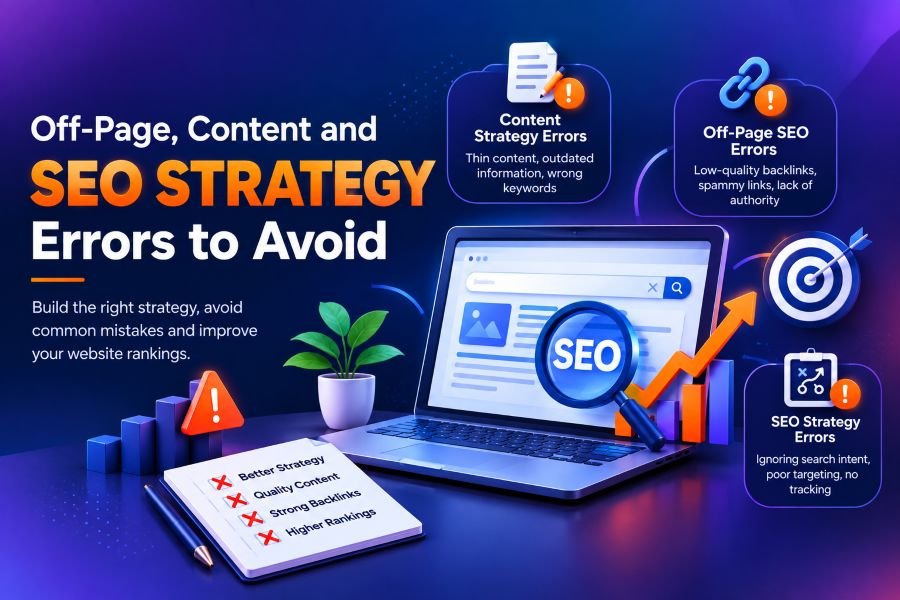
SEO is not about fixing technical problems. Your overall content and authority-building strategy also influence performance.
Publishing Thin or Outdated Content
Creating hundreds of low-value pages does not automatically increase rankings. Google encourages websites to create original, reliable content that serves their audience.
Instead of continuously publishing new articles, review existing content.
Update:
Outdated statistics
examples
Broken links
Titles and headings
Search intent
Missing sections
Internal links
Images
Outdated service information
If an article no longer provides value, consider improving it substantially or removing it when appropriate.
Building Low-Quality Backlinks
Backlinks can help search engines understand the reputation and relevance of websites, but chasing numbers of low-quality links is not a sustainable SEO strategy.
Avoid link-building practices such as irrelevant link schemes, paid links intended to manipulate rankings, spammy directories and excessive exact-match anchor text.
Focus on earning relevant links through:
Original research
High-quality guides
Industry resources
Digital PR
Useful statistics
Expert contributions
Tools and resources
Genuine partnerships
Ignoring Local SEO
For businesses serving specific locations, local SEO can be an important source of qualified leads.
Maintain business information across relevant platforms, create location-relevant content where useful and ensure your website clearly communicates the areas and services you serve.
For a marketing agency such as Nextr Technology, location-focused pages can be valuable when they genuinely serve different audiences and provide unique information rather than simply changing a city name on identical pages.
Not Tracking SEO Performance
One of the SEO errors is making changes without measuring the results.
Use tools such as Google Search Console and analytics platforms to monitor:
Organic clicks
Impressions
Search queries
Average position
Indexed pages
Coverage issues
Organic conversions
Landing-page performance
SEO is a process. A successful strategy involves testing, measuring, improving and repeating.
Expecting Instant SEO Results
SEO rarely produces results overnight. Rankings can take time because search engines need to crawl, index, evaluate and compare content against competing pages.
Google also makes clear that following SEO practices does not guarantee that a particular page will be indexed or rank first.
The better approach is to build a long-term SEO strategy based on content, strong technical foundations, relevant keywords, quality user experience and continuous improvement.
How to Fix SEO Errors. Improve Website Rankings
Start with a complete SEO audit rather than making random changes. Check your website’s health, content quality, keyword targeting, internal links, backlinks, mobile experience, indexing status and page performance.
A practical SEO improvement process can include:
Audit SEO – Check crawlability, indexability, redirects, HTTPS, canonical tags, sitemap and robots.txt.
Review keyword targeting – Identify keywords that match your audience and search intent.
Improve existing content – Update thin pages with useful original information.
Optimise on-page elements – Improve titles, headings, URLs, images, internal links and meta descriptions.
Improve experience – Make sure important content is accessible and easy to use on smartphones.
Improve website performance – Optimise images, scripts, code and server performance.
Build authority – Earn quality backlinks from trustworthy and relevant websites.
Monitor Google Search Console – Track indexing, queries, clicks, impressions and technical issues.
Measure conversions – Focus not on rankings but also on leads, enquiries, sales and business results.
The goal should not be to trick Google’s algorithms. The goal should be to create a website that people really find helpful. That search engines can easily see and understand.
Frequently Asked Questions
1. What are the common SEO mistakes?
Common SEO mistakes include putting many keywords in one place, having content that is the same as other websites not matching what people are looking for having a website that loads slowly not linking pages well within the site not making the site work well on phones problems with getting the site added to search engines links that do not work content that is not enough and getting links from low-quality websites.
2. Can SEO mistakes cause a website’s rankings to drop?
Yes. Technical issues, content using unfair methods, making big changes to the website, problems with getting the site added to search engines, and strong competition can all make rankings go down. A full SEO check can help find reasons.
3. Is keyword stuffing effective for SEO?
No. Keyword stuffing is a practice that does not work anymore. It makes content hard to read. Google suggests writing natural content and made for people. It also says that keyword stuffing is a practice.
4. How important is mobile optimisation for SEO?
Mobile optimisation is very important because Google uses the mobile version of website content for listing and ranking. Companies should make sure that people on phones can access the important content and features as people on computers.
5. How can I find SEO problems on my website?
Start with Google Search Console, tools that look at website data from analytics, check how fast the website loads and look at pages by hand. A professional SEO check can also find on-page issues, content issues and off-page issues that might be stopping good results.
Conclusion
SEO success in 2026 needs more than adding keywords and writing blogs every day. Websites need a mix of technical SEO, helpful content, making sure the content matches what people want, making sure the site works well on phones, linking pages well, making the site load fast and building trust and authority.
The important step is to stop thinking of SEO as something that only needs to be done once. People’s search habits, competitors, content, technology and websites all keep changing. Regular SEO checks can help find mistakes before they become problems.
By removing SEO mistakes and focusing on useful, real content that people like, companies can build a better base for long-term visibility. Google says no way to put a website at the top. Good SEO starts with making content that’s helpful and easy to use for both users and search engines.
For companies that want to make their online presence stronger, Nextr Technology can use this way as a base for an SEO plan focused on long-term visibility, good traffic and real business growth.
Thank you for reading
Buy Latest Tech Gadgets and Laptops: Click Here
Buy Web Hosting at an affordable price: Buy Now.
If you want to build your website at an affordable price, contact www.nextrtechnology.com
If you want to build your website at an affordable price, contact www.nextrtechnology.com
Read more blogs: https://www.nextrtechnology.com/blog/