GEO vs SEO: What Businesses Need to Know About AI Search
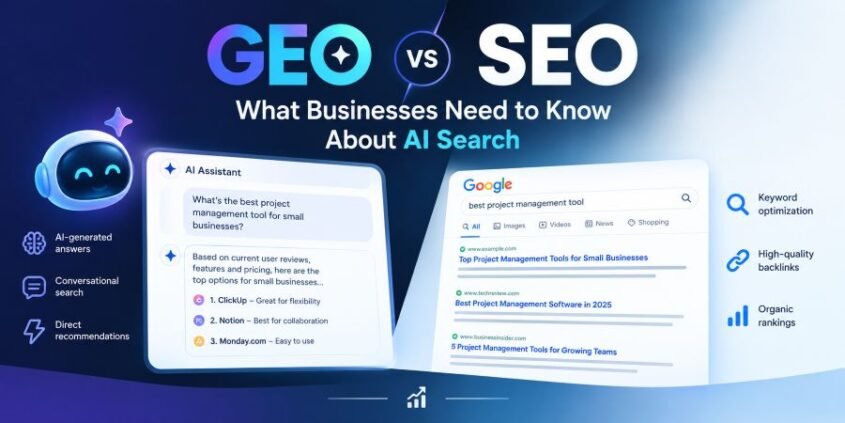
Search is changing fast. People are no longer going through lists of links. Clicking from one site to another just to find an answer. Instead, they rely on AI-powered search tools that can pull together information from sources and give direct answers to questions. This shift has brought attention to a focus—Generative Engine Optimisation or GEO—alongside the more familiar practice of Search Engine Optimisation or SEO.
For businesses, this change does not mean SEO is disappearing. It means SEO and GEO are now connected strategies. They work together to help a business stand out in both search results and AI-driven search experiences. Google has updated its advice to say that even as generative AI features grow, the core principles of SEO still matter.
Knowing how GEO and SEO differ helps companies make content that people can find, trust and use. It also helps search engines and AI systems understand what the company offers.
What Is SEO? How Is GEO Different?
SEO stands for Search Engine Optimisation. It’s about making sure a website ranks well in search results like those you see on Google. SEO looks at things like keyword research, understanding what users want when they search, website speed, mobile-friendliness, internal linking, backlinks, structured data and whether search engines can crawl the site properly. The goal is to bring in visitors who are looking for products, services, information or help.
GEO, or Generative Engine Optimisation, is different. It focuses on making sure that a brand, website, product or piece of content can be understood and used by AI-powered search tools. Instead of only trying to rank high in a list of blue links, GEO aims to create content that clearly explains ideas, supports context and gives authoritative information that AI systems can reference when creating answers.
The main difference lies in the user experience. Traditional SEO wants a webpage to show up high for queries so people will click through and visit the site. GEO works in a setting where AI may pull together multiple sources to build a summary. A user might then decide which source to explore further.
Businesses should not treat GEO and SEO as totally separate. Google says that strong SEO practices still apply to success in AI features. For example, if a company sells web development services, it would normally optimise a page for keywords like “website development company” or “professional web development services.” With a GEO approach, the same company would improve the content by explaining what services it offers, what technologies it uses, why clients benefit, what industries it serves, how the process works and common questions customers ask.
This kind of content helps real people read and understand. It also makes it easier for search systems and AI tools to recognise the value of the business.
Why Businesses Need Both SEO and GEO in the AI Search Era
AI-powered search isn’t taking over search. It’s adding ways for people to find information. That means businesses still need to stay visible in search results. They now have extra chances to appear in AI-generated summaries and responses.
SEO remains important because search engines still must crawl, analyse, index and judge webpages. If a site is slow, poorly structured, has poor content, or blocks access, it won’t show up—no matter whether the target is a simple search or an AI result. Google says websites must be crawlable and indexable for their content to be available in any search experience.
GEO adds another layer. It asks businesses to think beyond keywords. Instead of repeating words just to rank, GEO encourages creating content around meaning, context, expertise and what users really want to know.
For instance, when writing a short article titled “SEO Services “, a better plan could explain what SEO entails, how technical SEO differs from on-page SEO, why local SEO matters, how to measure SEO success and what affects organic visibility. Such in-depth content answers related questions naturally and serves readers better.
This is especially useful since AI searches often involve complex questions. Users may ask things like “Which digital marketing strategy’s best for a small business?” How can an ecommerce website increase organic traffic?” These require detailed answers—not just a few keyword phrases.
Businesses should create content that directly solves customer problems. Use headings, short explanations, real examples, original insights and facts with proper sources when needed. Connect supporting pages with links so both people and search engines can follow the relationships between topics.
Another key point is originality. Creating lots of pages written by AI just to hit keyword targets is not a good plan. Google warns against large-scale content made mainly to trick search rankings without offering value to users.
Instead, businesses should use AI as a helper. Let it assist in research, idea organisation, or drafting content. Always keep human review, real expertise, accurate facts and editorial quality at the centre.
How to Build an SEO + GEO Strategy for Your Business
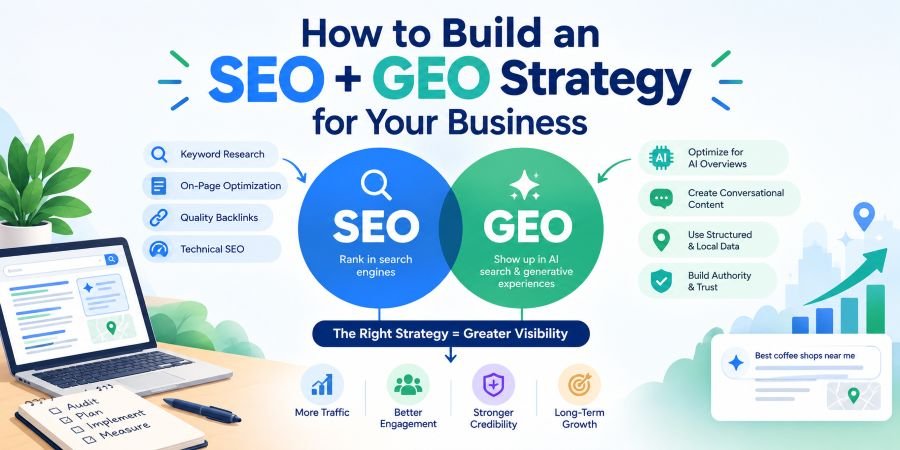
The move for businesses in 2026 is not picking one strategy over the other. It’s building an SEO and GEO plan.
Start with technical SEO. Make sure your website can be found and crawled by search engines. Pages should load quickly, URLs should make sense, navigation should be easy, important content should be accessible, and the site should work well on all devices.
Then create content based on topics rather than single keywords. Think about what your audience searches for during each step of buying a product or service. Develop service pages, educational blogs, comparison articles, guides, FAQs, case studies and content specific to your industry. Write these so they answer questions.
Your content should show knowledge. Avoid statements that could appear on thousands of websites. Offer explanations, practical examples, industry trends, processes and helpful tips. This builds authority and helps search systems and AI better understand your brand.
Entity clarity is also growing in importance. Clearly state your company name, services offered, location, industry, expertise, contact details and other relevant business information across your site. Use data where it fits. Keep your business details consistent.
Don’t forget brand mentions and authority signals. When trusted websites, news outlets, industry sites or influencers talk about your business, it boosts credibility. You don’t want to game the system—just build an online presence that shows your company is a reliable source.
Measurement needs to adapt. Traditional SEO metrics like clicks, impressions, rankings, conversions, indexed pages and engagement are still useful. Google Search Console now includes data on AI-related Search experiences, including how AI Mode contributes to traffic reports.
The long-term goal is simple: make information that people trust and search systems can understand. SEO helps get discovered across search engines. GEO prepares your content for an AI-driven future.
Conclusion
The discussion about GEO versus SEO shouldn’t be about choosing one over the other. SEO lays the foundation— strength, structure and content relevance. GEO builds on that by helping content become clearer, more meaningful, authoritative and understandable for AI-powered search.
As AI Search continues to evolve, businesses that invest in high-quality content, solid technical SEO, topical authority, structured data, genuine expertise and great user experiences will have the chance to stay visible.
For Nextr. in and other businesses wanting to strengthen their presence, the best path forward is combining traditional SEO basics with a content style ready for AI search. The future of search isn’t about ranking for keywords. It’s about becoming a trusted source that can be found, understood and relied upon across all types of search.
FAQs
1. What is the difference between GEO and SEO?
SEO focuses on improving visibility in search results. GEO focuses on making content useful, understandable and discoverable within AI-powered search experiences.
2. Is GEO replacing SEO?
No. GEO is not replacing SEO. Strong technical SEO, crawlability, indexing, valuable content and other established SEO practices remain essential for visibility in Google’s AI features.
3. How can businesses optimise content for AI Search?
Businesses should create helpful, well-structured content that clearly answers user questions, demonstrates expertise, provides context and uses descriptive headings and logical internal links.
4. Does AI-generated content help with GEO?
AI can assist in researching, organising, and drafting content. Producing large amounts of generic AI-written pages just to target keywords is not a good GEO or SEO strategy. Google warns against scaled content made primarily to manipulate rankings without user value.
5. Should my business invest in both SEO and GEO?
Yes. A combined strategy helps maintain organic search visibility while preparing content and brand presence for AI-powered search experiences, like AI Overviews and AI Mode.
Thank you for reading
Buy Latest Tech Gadgets and Laptops: Click Here
Buy Web Hosting at an affordable price: Buy Now.
If you want to build your website at an affordable price, contact www.nextrtechnology.com
If you want to build your website at an affordable price, contact www.nextrtechnology.com
Read more blogs: https://www.nextrtechnology.com/blog/