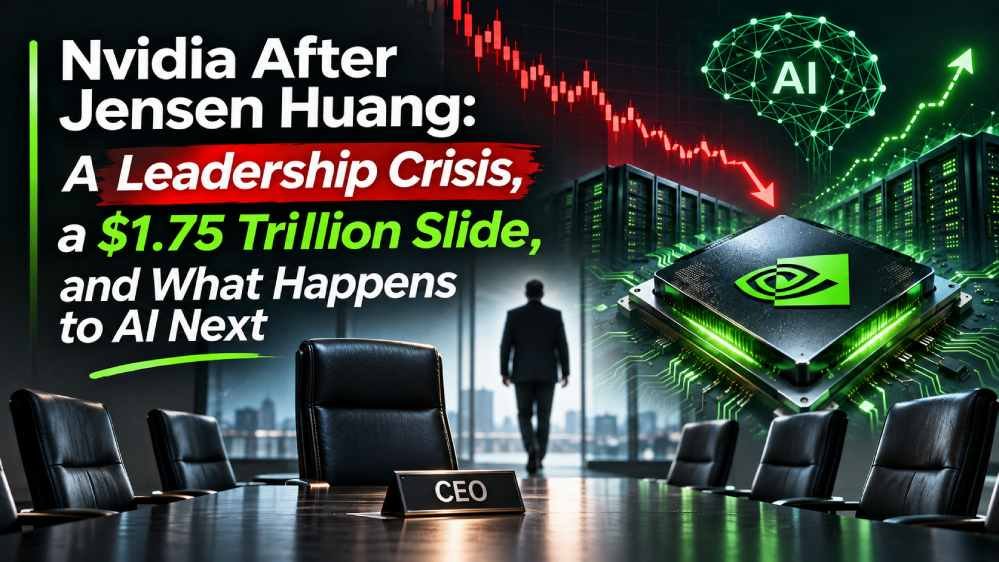
The most important company in the AI boom lost its founder this week. On November 12, 2026, Nvidia announced that Jensen Huang had resigned as CEO and as a board member after 33 years, ending an era in which he turned a graphics-chip maker into a $4 trillion company at the centre of artificial intelligence. Chief financial officer Colette Kress is now interim CEO.
The exit followed days of reports about Huang’s personal conduct, and it has set off a chain reaction: a sharp stock decline, a scramble over succession, government investigations, and uncertainty across the AI supply chain. This post focuses on the business and technology fallout, with figures as of November 16.
Quick facts
- Jensen Huang resigned as Nvidia CEO and director on November 12, 2026; CFO Colette Kress is interim CEO.
- Nvidia’s market value has fallen roughly $1.75 trillion from its early-October peak of about $5.75 trillion.
- The board is searching internally and externally for a permanent CEO; Ian Buck, Rene Haas, and Chris Malachowsky are among names floated.
- Nvidia reports third-quarter earnings on Tuesday, November 17, with analysts expecting revenue near $109 billion.
- Nvidia’s roughly $13 billion Hugging Face acquisition, reported earlier this year, remains pending.
What Happened: A Week That Reshaped Nvidia
The sequence moved fast. On November 8, Huang admitted to an affair, according to reports, in a message to employees. Further reports followed, including one from The New York Times on November 11, describing relationships with Nvidia employees. Media coverage also said one relationship was with a woman whom US officials allege has links to Chinese intelligence, which turned a personal story into a national-security question.
Nvidia’s board met late on Wednesday, November 11, and decided to remove Huang, according to a person familiar with the matter cited by CNBC. The company announced his resignation the next day, named Kress interim CEO, and said it would consider internal and external candidates for the permanent role. Nvidia’s statement did not include a comment from Huang, who has stayed largely silent in public.
Why Nvidia Matters So Much to AI
Nvidia’s GPUs are the backbone of AI training and inference, which is why a leadership shock lands so hard. In August, the company reported record second-quarter revenue of $96.2 billion, up 106% from a year earlier, with roughly $89 billion coming from data centres. It guided to about $108 billion for the current quarter, and Amazon Web Services announced plans to deploy an additional 2 million Nvidia GPUs through 2028.
That scale means Nvidia’s decisions on pricing, supply, and partnerships ripple through cloud providers, AI labs, and startups. Huang was also the face of that ecosystem, lobbying governments and anchoring investor confidence, so his departure removes both an executive and a public voice.
The Market Reaction
Nvidia’s stock fell as much as 13% on the day of the announcement before retail buyers stepped in, leaving it down 4.34% at the close, roughly $182 billion in lost value. On Friday it fell another 2%, closing below a $4 trillion market value for the first time since July 2025. For the week, it dropped nearly 13%, its sixth straight weekly decline and the longest such streak since 2012.
The effect spread beyond one company. Tech-heavy stock benchmarks in Taiwan and South Korea each fell more than 2.5% on Monday, and Nvidia shares were down again in premarket trading. At least ten Wall Street analysts have downgraded the stock from Buy to Hold, citing an unclear succession plan, though others argue the business is unchanged. Retail investors have kept buying the dip: on the day of the announcement, Robinhood users reportedly bought twice as much Nvidia stock as all other stocks combined.
Who Could Be the Next Nvidia CEO?
Kress, who has been CFO for years, holds the job on an interim basis. Names discussed by analysts and the press include Ian Buck, a 22-year Nvidia veteran who created the CUDA software that underpins the company’s chips and who is favoured at roughly 40% on prediction markets, Arm CEO Rene Haas, who ran a business unit at Nvidia before leaving in 2013, and co-founder Chris Malachowsky.
Politics has entered the picture. Reports say Treasury Secretary Scott Bessent urged the board to hire an outside CEO, and President Trump floated former Apple CEO Tim Cook, a long shot on prediction markets at around 5%. Meanwhile, an online petition to reinstate Huang has passed 170,000 signatures, with backing from prominent tech figures including Elon Musk, and he has reportedly considered a comeback. The board has not signalled that it will reverse course.
Investigations and Political Fallout
The scandal is not only about corporate governance. Nvidia is conducting an independent investigation, and reports say the Justice Department is examining a chip-smuggling campaign tied to a Singapore-based company previously led by the woman at the centre of the allegations. Bloomberg also reported that the US Attorney’s Office in Manhattan is looking at whether organisations linked to her were involved in diverting Super Micro server products.
CNN reported that Huang has been summoned to testify before Congress, and he has reportedly hired lawyers. None of these probes has produced findings, and the allegations remain allegations. Still, analysts such as HSBC’s Frank Lee flagged that congressional scrutiny could lead to tighter export restrictions, which is a real risk for a company whose growth depends on selling advanced chips internationally.
Does This Change the AI Business?
In the near term, probably not. Nvidia books orders well in advance, so analysts say the turmoil won’t affect results this quarter or next. Wall Street expects third-quarter revenue near $109 billion, almost double a year ago. Wedbush’s Matthew Bryson argued that nothing fundamental has changed and expects another beat.
The longer-term questions are about leadership. Huang had around 60 direct reports and, critics note, no clear successor, which analysts call extreme key-person risk. HSBC pointed to pricing power with customers and bargaining power with suppliers as areas a new CEO must protect. The Trump administration also plans to designate more than two dozen AI companies, including Nvidia, as national champions, according to the Wall Street Journal, so government relationships will matter more, not less.
For the Hugging Face deal, reported at close to $13 billion and still pending, the leadership change raises questions about timing and the platform’s open-source future.
What to Watch This Week
- Earnings on November 17: revenue, guidance, and any commentary from Kress on leadership and demand.
- The CEO search: whether the board names a permanent leader, and whether it looks inside or outside.
- Investigations: updates from Nvidia’s independent probe, the Justice Department, and Congress.
- Export policy: any signals on tighter chip restrictions.
- Deals: the status of the Hugging Face acquisition and customer commitments.

What It Means for Businesses and Developers
If you buy or rent AI computing, there’s no sign of a supply disruption, but this is a reminder to avoid single-vendor dependence where practical. Compare cloud and chip options, build portability into your AI workloads, and watch for export-rule changes if you operate across borders. For investors, volatility is likely to continue. This is general information, not financial advice.
Conclusion
Nvidia’s business is still riding enormous demand, but the company has lost its founder, its public face, and the central figure of the AI boom in a matter of days. The coming weeks will test whether Kress and the board can steady the ship, name a credible successor, and keep investigations from spilling into the company’s operations and export access.
For now, earnings on Tuesday will show whether demand holds. The harder question is whether Nvidia can keep its edge without the leader who built it, and what that means for the wider AI industry that depends on its chips.
Frequently Asked Questions
Why did Jensen Huang resign as Nvidia CEO?
Nvidia’s board announced his resignation on November 12, 2026, after days of reports about his personal conduct, including relationships with employees and a woman US officials allege has links to Chinese intelligence. Huang admitted to an affair, according to reports, and has otherwise stayed largely silent.
Who is Nvidia’s interim CEO?
Chief financial officer Colette Kress is interim CEO. The board is searching for a permanent replacement and will consider both internal and external candidates.
Who could be Nvidia’s next CEO?
Names discussed include Nvidia executive Ian Buck, Arm CEO Rene Haas, and co-founder Chris Malachowsky. Reports also say Treasury Secretary Scott Bessent urged an outside hire, and President Trump floated Tim Cook. The board hasn’t announced a decision.
How has Nvidia’s stock reacted?
Shares fell as much as 13% on November 12 and closed down 4.34%, then dropped another 2% on Friday, leaving Nvidia’s market value below $4 trillion for the first time since July 2025. It has lost roughly $1.75 trillion since its early-October peak.
When does Nvidia report earnings?
Nvidia is scheduled to report third-quarter fiscal 2027 results on Tuesday, November 17, 2026. Analysts expect revenue near $109 billion. Check the final numbers after the report.
What happens to Nvidia’s Hugging Face acquisition?
The roughly $13 billion deal, reported earlier this year, is still pending. The leadership change has raised questions about its timing and the future of the open-source platform.
Thank you for reading
Buy Latest Tech Gadgets and Laptops: Click Here
Buy Web Hosting at an affordable price: Buy Now.
If you want to build your website at an affordable price, contact www.nextrtechnology.com
If you want to build your website at an affordable price, contact www.nextrtechnology.com
Read more blogs: https://nextrtechnology.com/blog/