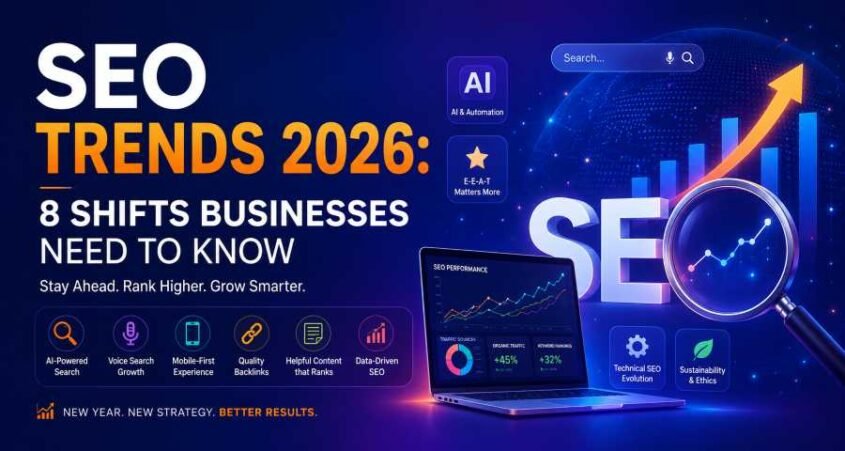
SEO Trends 2026: 8 Shifts Businesses Need to Know
For years, “SEO” essentially meant one thing: ranking on Google’s results page. That definition is quietly breaking apart in 2026. Roughly 17% of U.S. consumers now use AI chatbots for search-like queries, 31% turn to Instagram to find local business reviews, and 20% use TikTok as a review platform in its own right. Search hasn’t disappeared — it’s fragmented across formats and platforms in a way that’s forcing businesses to rethink what “being found online” actually requires. Here’s a look at the SEO trends genuinely reshaping how businesses get discovered in 2026, beyond the usual AI Overview headlines.
The SEO Trends Businesses Need to Know
1. Video Becomes a Primary Search Format
Video is increasingly where people search first, not just where they end up. YouTube continues to function as one of the world’s largest search engines in its own right, and short-form video is showing up directly inside traditional search results more often. For businesses, this means video titles, timestamped descriptions with relevant keywords, and clear captions now deserve the same optimization attention as a webpage’s title tag and meta description.
2. Visual Search and Google Lens Go Mainstream
Consumers are increasingly searching with images instead of words. Google Lens lets someone photograph a product and get instant, relevant results, and this capability is becoming central to how people discover brands. High-quality, varied product and environmental photography across a website isn’t just a design choice anymore — it’s a genuinely searchable asset that visual search algorithms rely on.
3. Search Fragments Across Multiple Platforms
Traditional Google rankings are just one piece of discovery now. With meaningful shares of consumers using AI chatbots, Instagram, and TikTok as search and review tools, businesses need a genuinely cross-platform visibility strategy — consistent business information, voice-optimized content for assistants like Alexa and Siri, and visual-first content built for social discovery, not just a webpage optimized for one search engine.
4. Local SEO Enters a New Era
Local search is being reshaped by AI-powered local packs and voice assistants that answer queries directly, without necessarily sending a click to a business’s website. Some businesses are noticing organic click-to-call rates decline even while their Google Business Profile rankings hold steady — a sign that visibility and conversion are decoupling in ways local SEO strategy hasn’t had to account for before. Expanding Local Services Ads, more (including anonymous) Google reviews, and increasingly hyper-local, neighborhood-specific content are all part of adapting to this shift.
5. Organic Traffic Volume Declines, But Intent Quality Rises
As AI systems increasingly answer informational queries directly within the search results page, overall click-through volume is falling for many content types, especially on mobile. The visitors who do click through, however, tend to be considerably further along in their decision-making process. The practical shift for SEO strategy: measuring success by intent and conversion quality, not just raw traffic volume, since fewer, more qualified visits can outperform a larger number of shallow ones.
6. Branded Search Becomes a Strategic SEO Priority
AI-powered search systems tend to favor branded queries, since a search that already includes a brand name carries stronger trust and intent signals than a generic, non-branded search. This is turning brand-building and awareness campaigns into a genuine SEO input rather than a separate marketing line item — it’s often more effective to strengthen visibility among people who already know your brand than to keep chasing colder, high-volume generic keywords with declining organic impressions.
7. AI-Generated Local Answers Become the Front Door to Search
Increasingly, people ask AI systems for local recommendations without ever navigating to a traditional results page, or they read an AI Overview and choose a business mentioned there without engaging with the local map pack at all. These AI systems rely heavily on clear, well-structured business information — making structured data and consistent, accurate listings across the web more important than ever for local visibility.
8. E-E-A-T Signals Become More Automated and Measurable
While Experience, Expertise, Authoritativeness, and Trustworthiness has guided Google’s human quality raters for years, 2026 is seeing these signals evaluated more directly by automated systems — things like clearly displayed author credentials, citation frequency from authoritative external sources, and how recently a page has been meaningfully updated. Anonymous, uncredited content is increasingly at a real disadvantage compared to clearly authored, well-sourced pages.
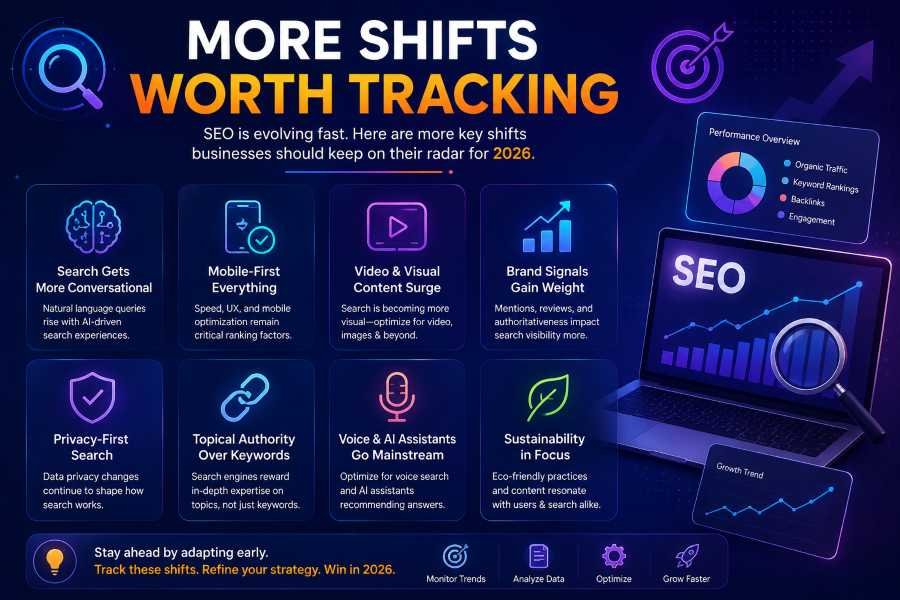
More Shifts Worth Tracking
- Structured data (schema) is expanding beyond text to help AI and search systems interpret video, local business details, and product data more accurately.
- Content decay is being taken more seriously, with regular refresh cycles for cornerstone pages replacing a “publish and forget” approach.
- First-party data is becoming more valuable for personalization and targeting as privacy restrictions limit third-party tracking options.
- Quality control on AI-assisted content is tightening, as search systems get better at distinguishing genuinely useful content from high-volume, low-effort AI output.
- Featured snippets and knowledge panels continue capturing a larger share of screen real estate on competitive queries, making concise, well-structured answers near the top of a page increasingly valuable.
What This Means for Your Business
The common thread across every trend here is diversification. Businesses that treated Google’s organic results as their entire SEO strategy are finding that approach increasingly incomplete in 2026. The stronger position is building visibility across the formats and platforms your specific customers actually use — which might mean investing more heavily in video for some businesses, doubling down on hyper-local content and reviews for others, or simply making sure your existing content has the structured data and clear authorship that both traditional search and AI systems now expect.
How to Prioritize These Trends for Your Business
Not every business needs to chase all eight trends at once, and trying to do so usually spreads resources too thin to make real progress anywhere. A more practical approach is to audit where your specific customers are actually discovering businesses like yours — a local service business will likely get more value from investing in Google Business Profile optimization, reviews, and hyper-local content than from a heavy video strategy, while a product-based e-commerce brand may see a much bigger return from visual search readiness and high-quality imagery. Start with one or two channels where your audience genuinely spends time, execute them properly with consistent authorship and structured data, and expand from there once you have real performance data to guide the next investment.
Conclusion
SEO in 2026 hasn’t become less important — it’s become less centralized. Video, visual search, local discovery, and branded search are all pulling weight that used to belong almost entirely to traditional organic rankings, and businesses that adapt their strategy across these channels are the ones staying genuinely visible. The fundamentals of good SEO — quality, relevance, and trust — haven’t gone anywhere; they’re just now being tested across a lot more surfaces than a single search results page.
Frequently Asked Questions (FAQs)
Q1. Is SEO still relevant in 2026?
Yes — SEO isn’t disappearing, it’s expanding. The core goal of being genuinely visible where your customers are searching hasn’t changed, but 2026 SEO now spans video platforms, visual search, and multiple discovery channels, not just Google’s traditional blue-link results.
Q2. Why is video considered a major SEO trend in 2026?
Video has become one of the primary formats people use to search, with YouTube functioning as one of the largest search engines in its own right. Optimizing video titles, timestamped descriptions, and captions is increasingly as important as optimizing a webpage’s on-page SEO elements.
Q3. What is visual search, and why does it matter for businesses?
Visual search tools like Google Lens let users photograph a product or object and get instant search results based on the image itself, rather than typing a query. For businesses, this makes high-quality, diverse product and environmental imagery a genuine searchable asset, not just a design choice.
Q4. Why is local SEO changing so much in 2026?
Local search is increasingly being answered directly by AI-generated local packs and voice assistants, and some businesses are seeing organic click-to-call rates decline even while their Google Business Profile rankings hold steady. This is pushing local SEO strategy toward multi-platform visibility (search, social platforms, and AI assistants) rather than Google rankings alone.
Q5. Does organic traffic declining mean SEO is failing?
Not necessarily. As AI systems answer more informational queries directly on the search results page, overall click volume for some content types is falling, but the visitors who do click through tend to be further along in their decision-making process. The practical shift is toward valuing intent and conversion quality over raw traffic volume.
Q6. Why is branded search becoming a bigger SEO priority?
AI-powered search systems tend to favor branded queries, since they carry stronger trust and intent signals than generic, non-branded searches. This is turning brand-building and awareness campaigns into a genuine SEO strategy component, not just a separate marketing activity.
Thank you for reading
Buy Latest Tech Gadgets and Laptops: Click Here
Buy Web Hosting at an affordable price: Buy Now.
If you want to build your website at an affordable price, contact www.nextrtechnology.com
If you want to build your website at an affordable price, contact www.nextrtechnology.com
Read more blogs: https://www.nextrtechnology.com/blog/