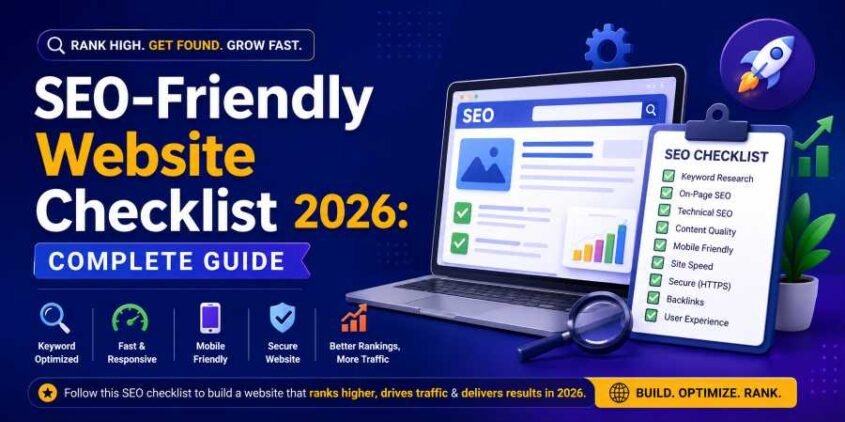
How to Build an SEO-Friendly Website in 2026: The Complete Checklist for Higher Google Rankings
Here’s something businesses discover the hard way: you can have genuinely useful content, solid backlinks, and a team that’s done everything right on the content side — and still watch your rankings refuse to budge. Nine times out of ten, the culprit is technical. A one-second delay in page load time can reduce conversions by up to 7 percent, and more than half of mobile visitors abandon pages that take longer than three seconds to load. You can write the best article on the internet, but if search engines can’t crawl it properly or it loads too slowly, that content simply isn’t going to rank. Here’s a complete, practical checklist for building a genuinely SEO-friendly website in 2026, covering everything from site structure to AI search readiness.
Why SEO Needs to Be Planned Before Development, Not After
SEO is often treated as a final task, something to sprinkle on after a website is designed and built. That’s backwards. Site architecture, navigation, URL format, mobile experience, and page speed all directly affect how easily search engines can crawl, understand, and rank a website, and every one of these is far more expensive and disruptive to fix after launch than to get right from the start. Treating SEO as a planning input, not a launch-day checklist item, is the single biggest mindset shift that separates websites that rank from ones that don’t.
The Complete SEO-Friendly Website Checklist
1. Build a Logical Site Architecture
Every important page on your website should be reachable within three clicks from the homepage. Pages buried deeper receive less crawl attention from search engines and tend to rank less effectively as a result. A clean, logical structure with clear internal linking makes it easy for both users and search engine crawlers to understand how your content relates and where to find what they need.
2. Use Clean, Readable URL Structures
Descriptive URL slugs that mirror your page content consistently outperform messy ones. Avoid query strings, dates, and random ID numbers in your URLs — a clean, readable URL both ranks better and earns more clicks from search results, since users can see exactly what a page is about before they even click.
3. Nail Your Core Web Vitals
Core Web Vitals are Google’s official, confirmed ranking signals for real-world user experience. The 2026 benchmarks to aim for: Largest Contentful Paint (LCP) under 2.5 seconds, Interaction to Next Paint (INP) under 200 milliseconds, and Cumulative Layout Shift (CLS) below 0.1. In practice, this means compressing and properly sizing images (WebP or AVIF formats), minimizing render-blocking CSS and JavaScript, preloading key fonts, and keeping space reserved for images and ads so elements don’t shift while the page loads.
4. Design Mobile-First, Not Just Mobile-Responsive
Google evaluates the mobile version of your website for ranking purposes, and with well over 60 percent of users now browsing from mobile devices, a site that’s merely “responsive” isn’t enough. Genuinely mobile-first design means fast loading, mobile-friendly navigation, readable fonts, and proper spacing built for small screens from the ground up, not squeezed in as an afterthought.
5. Optimize Your On-Page Elements
Title tags, meta descriptions, heading structure (H1 through H3), and image alt text remain foundational, even as search evolves. Use semantic HTML so both search engines and assistive technology can accurately understand the structure and purpose of your content, not just its appearance.
6. Implement Structured Data (Schema Markup)
Structured data helps search engines, and increasingly AI systems, understand exactly what your content represents, whether that’s an article, a product, an FAQ, or a local business listing. It’s one of the clearest ways to make your content eligible for rich results and AI-generated summaries rather than just a plain blue link.
7. Make Your Website AI-Search Ready
With AI Overviews and answer engines now shaping a growing share of search results, technical SEO in 2026 extends beyond traditional crawlability. To make content genuinely AI-readable, provide direct answers early, use clear heading structures, define important terms plainly, include helpful tables and checklists, and add FAQs — all while keeping content factual, specific, and easy to extract accurately.
8. Secure, Fast Hosting Infrastructure
Confirm HTTPS across every indexable URL with no mixed content, and audit for insecure third-party scripts or plugin bloat that expands your site’s attack surface. On performance, modern protocols like HTTP/3 and edge hosting providers can meaningfully improve load times, especially combined with minified CSS, JavaScript, and HTML files.
9. Build Internal Links Around Topic Clusters
Rather than publishing isolated, disconnected pages, organize content around pillar pages with supporting cluster content that links back to them. This structure signals topical authority to search engines and makes it far easier for both users and crawlers to navigate related content on your site.
10. Treat SEO as an Ongoing System, Not a One-Time Task
The sites that rank consistently run a structured maintenance routine: weekly checks of Google Search Console and Analytics, monthly page speed reviews, and a full technical SEO crawl audit at least quarterly. Sites that maintain this kind of consistent rhythm reliably outperform those that only do occasional, large one-off audits.
Common Mistakes That Hurt SEO-Friendliness
- Launching a redesign without redirecting old URLs, causing broken links and lost rankings.
- Loading an entire page’s JavaScript bundle instead of only what’s needed for that specific page.
- Skipping alt text and semantic heading structure in favor of purely visual formatting.
- Treating mobile design as an afterthought rather than the primary experience to design for.
- Publishing schema markup that doesn’t actually match the visible content on the page.
Tools to Monitor Your Website’s SEO Health
You don’t need a large toolkit to stay on top of technical SEO, but a few core tools make monitoring far more manageable. Google Search Console remains essential for tracking indexing status, crawl errors, and Core Web Vitals performance directly from Google’s own data. Google Analytics 4 helps you monitor organic traffic trends at the page level, showing which content is actually driving visits. PageSpeed Insights and Lighthouse provide detailed lab diagnostics for debugging specific speed issues on individual pages. For broader site-wide crawls, tools like Screaming Frog or Ahrefs Site Audit can surface technical regressions — broken links, missing metadata, duplicate content — that are easy to miss by manually checking pages one at a time.

Conclusion
Building an SEO-friendly website in 2026 isn’t about a single trick or plugin — it’s the sum of a logical site structure, clean URLs, strong Core Web Vitals, mobile-first design, structured data, and content that’s genuinely easy for both search engines and AI systems to understand. None of these elements work in isolation; a fast site with poor architecture still struggles, just as beautifully organized content on a slow site never gets the chance to be read. Treat this checklist as a foundation to build on from day one, and revisit it regularly, since technical SEO isn’t a launch task — it’s an ongoing discipline that determines whether all your other marketing efforts actually get seen.
Frequently Asked Questions (FAQs)
Q1. What makes a website SEO-friendly?
An SEO-friendly website is fast, mobile-first, easy for search engines to crawl and index, and organized with clear site architecture, clean URLs, and properly optimized on-page elements like title tags and headings. It also uses structured data to help both search engines and AI systems understand its content accurately.
Q2. What are Core Web Vitals and why do they matter?
Core Web Vitals are Google’s official user experience metrics: Largest Contentful Paint (LCP, ideally under 2.5 seconds), Interaction to Next Paint (INP, ideally under 200 milliseconds), and Cumulative Layout Shift (CLS, ideally below 0.1). They measure loading speed, responsiveness, and visual stability, and are a confirmed ranking signal.
Q3. Should SEO be planned before or after a website is built?
Before. Website structure, navigation, URL format, mobile experience, and page speed all affect how easily search engines can crawl and rank a site, and these are far harder and more expensive to fix after launch than to plan correctly from the start.
Q4. How important is mobile-first design for SEO in 2026?
Extremely important. Google primarily evaluates the mobile version of a website for ranking purposes, and with the majority of users now browsing on mobile devices, a site that isn’t genuinely optimized for mobile — not just responsive, but fast and easy to navigate on a small screen — will struggle to rank well.
Q5. What is structured data (schema markup), and do I really need it?
Structured data is a standardized code format added to a webpage that explicitly tells search engines and AI systems what the content means — for example, marking a page as a recipe, an FAQ, or a product listing. It’s increasingly important in 2026 as AI-powered search features rely on structured data to accurately summarize and cite web content.
Q6. How often should I audit my website’s technical SEO?
Most experts recommend a full technical SEO audit at least quarterly, alongside weekly checks of Google Search Console and Analytics and monthly page speed reviews. SEO isn’t a one-time launch task; sites that maintain a consistent monitoring routine tend to outrank those that only do occasional large audits.
Thank you for reading
Buy Latest Tech Gadgets and Laptops: Click Here
Buy Web Hosting at an affordable price: Buy Now.
If you want to build your website at an affordable price, contact www.nextrtechnology.com
If you want to build your website at an affordable price, contact www.nextrtechnology.com
Read more blogs: https://www.nextrtechnology.com/blog/