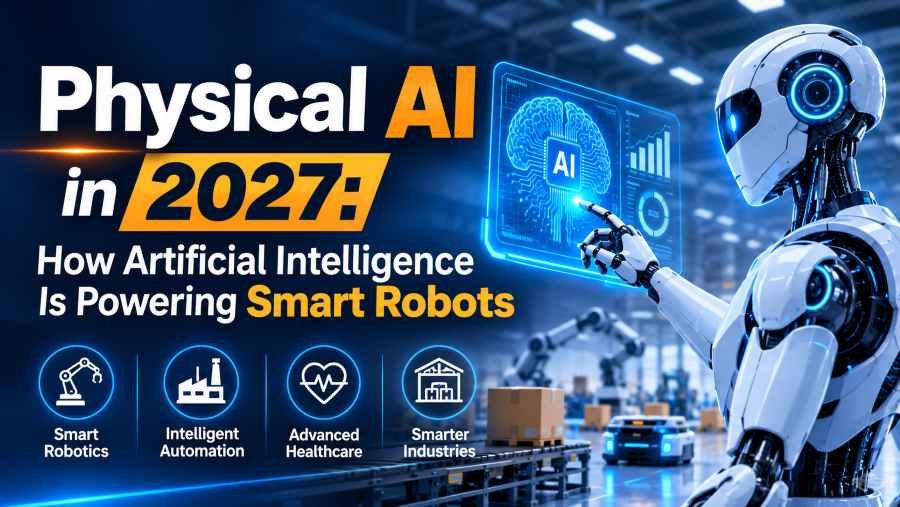
Artificial Intelligence is rapidly transforming the way businesses operate, and its next major evolution is moving beyond computer screens into the world. Physical AI is emerging as one of the exciting technology developments for 2027, combining artificial intelligence, robotics, machine learning, computer vision and advanced sensors to create intelligent machines that can understand their surroundings and perform real‑world tasks. Unlike automation systems that follow predefined instructions, Physical AI enables robots to observe their environment, make decisions, learn from experience, and respond to changing situations.
From manufacturing robots and autonomous warehouse systems to agricultural machines and healthcare assistants, Physical AI is creating new opportunities across industries. As businesses increasingly adopt automation to improve productivity, accuracy and operational efficiency, smart robots are expected to become a part of digital transformation. In 2027, Physical AI will play a role in connecting intelligent software with real‑world activities, helping organisations build smarter, faster and more adaptable operations.
What Is Physical AI? How Does It Power Smart Robots?
Physical AI refers to the integration of artificial intelligence into physical machines, robots and autonomous systems that interact with the real world. It allows machines to understand their surroundings through cameras, sensors, computer vision and other data collection technologies. Using machine learning and advanced AI models, these systems can analyse information, recognise objects, identify obstacles, and determine the actions to complete specific tasks.
Traditional industrial robots generally operate through fixed programming and repetitive instructions. They are designed to perform activities in controlled environments. However, Physical AI introduces an intelligent approach by allowing robots to adapt to unexpected changes and handle tasks that require greater flexibility. For example, an AI‑powered warehouse robot can identify packages, understand their positions, and move them without relying entirely on predefined movement instructions.
Several technologies work together to make Physical AI possible. Computer vision allows robots to recognise objects, people and environmental changes. Machine learning helps them improve their performance through training and experience. Natural language processing enables robotic systems to understand human instructions, while advanced sensors provide information about distance, movement, pressure and surrounding conditions. Edge computing also supports decision‑making by processing important information closer to the robotic hardware.
Another important development is embodied AI, which focuses on enabling intelligence to understand and interact with physical environments through robotic bodies. Combined with simulation technologies and advanced robotics models, embodied AI can help machines learn movements, test actions, and improve their ability to perform real‑world activities.
These capabilities are expected to make smart robots more useful in manufacturing, logistics, healthcare, agriculture and other industries throughout 2027.
Major Applications of Physical AI in Different Industries in 2027
Physical AI is creating possibilities for businesses by bringing intelligent automation into everyday industrial and commercial operations. One of its important applications is smart manufacturing. AI‑powered industrial robots can perform assembly, product inspection, material handling and quality control with accuracy. They can also identify production problems. Adjust certain operations according to changing requirements. This can help manufacturers reduce errors, improve productivity, and minimise operational downtime.
In logistics and warehousing,g Physical AI is helping develop robots capable of moving products, sorting packages, managing inventory and supporting order fulfilment. Autonomous mobile robots can navigate warehouse environments, recognise obstacles,s and transport materials between locations. These capabilities can improve supply chain efficiency. Reduce the time required for repetitive warehouse activities.
Healthcare is another sector where Physical AI could create improvements. Intelligent robotic systems can support hospital logistics, cs assist healthcare professionals with procedures, res and help manage repetitive operational tasks. Advanced surgical robotics and rehabilitation technologies are also benefiting from improvements in control systems. However, very medical applications require safety standards, professional supervision and appropriate regulatory approval.
Agriculture is also exploring the potential of robotics. AI‑powered agricultural machines can monitor crops, identify plant diseases,s detect weeds and support precision farming activities. Autonomous agricultural equipment can use cameras, sensors and machine learning to understand field conditions and perform selected tasks efficiently. These technologies may help farmers optimise resources, improve productivity and support agricultural practices.
Physical AI is also influencing the development of humanoid robots. These machines are designed with human‑like structures, including arms, legs and hands, ds allowing them to perform certain activities in environments originally designed for people. In the future, humanoid robots could support operations, warehouse activities, customer service, and selected household tasks. However, their ability to perform activities independently will continue to depend on improvements in AI reasoning, physical interaction, safety and hardware capabilities.
As these applications develop,p businesses will increasingly explore Physical AI to automate workflows,ws improve workplace safety, ety and create more efficient operating environments.
Benefits, Challenges and the Future of Physical AI in 2027
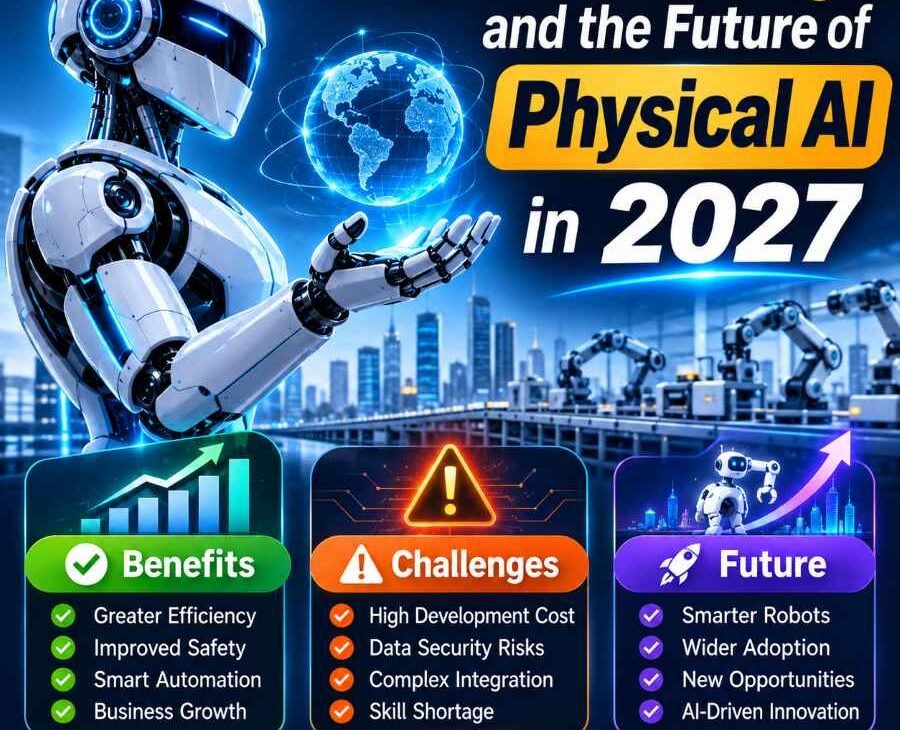
The growing adoption of Physical AI offers benefits for organisations. One of the advantages is improved operational efficiency. Intelligent robots can perform physically demanding activities with consistent accuracy, allowing employees to concentrate on more complex responsibilities. Businesses can also use automation to improve production speed,d reduce certain operational errors, rs and support better resource utilisation.
Workplace safety is another benefit. AI‑powered robots can be deployed in environments where human workers may face risks from extreme temperatures, heavy materials, dangerous chemicals or repetitive physical activities. With safety systems, ems these machines can support inspections, material transportation and selected industrial operations.
Physical AI can also improve decision‑making by combining real‑time sensor information with analysis. Businesses can use this information to understand equipment performance, identify operational problems, and improve workflow planning. As connectivity, edge computing and robotics technologies advance, intelligent machines may become more responsive and capable of working alongside employees.
Howeve,r Physical AI also comes with challenges. Developing robotic systems requires significant investment in hardware, software, infrastructure, training and maintenance. Businesses must also address data security, system reliability, workplace safety and integration with existing technologies. Another challenge is the ability of robots to perform consistently in environments. A machine that works successfully in a controlled testing environment may still experience difficulties when exposed to objects, changing lighting conditions or unexpected physical obstacles.
The availability of professionals is another consideration. Organisations will need experts in robotics engineering, artificial intelligence, machine learning, cybersecurity and automation to implement and maintain these systems.
Looking towards 20,27 the future of Physical AI will depend on improvements in AI models, robotic perception, simulation, edge computing and intelligent control systems. Instead of relying only on fixed automation, businesses will increasingly explore robots that can understand instructions,s adapt to their surroundings, gs and perform multiple related tasks.
For technology companies, developers and growing businesses,ses this creates opportunities to develop intelligent software, robotics platforms and AI‑powered business solutions. Companies that understand these developments and adopt the technologies can prepare themselves for the next generation of intelligent automation.
Conclusion
Physical AI in 2027 represents a step in the evolution of artificial intelligence and robotics. By combining machine learning, computer vision, sensors, edge computing and intelligent robotic systems, it is helping machines interact with the world more effectively. From manufacturing and logistics to healthcare and agriculture,e smart robots are creating opportunities to improve productivity, workplace safety and operational efficiency. Although challenges related to cost, security, reliability and implementation remain, continued technological advancements will expand the possibilities of automation. Businesses that explore Physical AI today can build a foundation for the future of robotics and digital transformation.
Frequently Asked Questions (FAQs)
1. What is Physical AI?
Physical AI is the integration of intelligence into robots and physical machines, es enabling them to understand their surroundings, make decisions,s and perform real‑world activities.
2. How is Physical AI different from AI?
Traditional AI primarily processes digital information, such as text, images and data. Physical AI connects intelligence with physical machines, es allowing them to sense, interact with,h and respond to real‑world environments.
3. What are the major applications of Physical AI in 2027?
Major applications include manufacturing, warehouse automation, autonomous mobile robots, healthcare robotics, agricultural automation and humanoid robots.
4. What are the main benefits of Physical AI for businesses?
Physical AI can improve efficiency, automate repetitive activities, support workplace safety,reduce certain human errors and help businesses make better operational decisions.
5. What is the future of Physical AI and smart robotics?
The future of Physical AI will involve intelligent, adaptive and autonomous robotic systems capable of performing complex tasks, collaborating with humans and supporting different industries.
Thank you for reading
Buy Latest Tech Gadgets and Laptops: Click Here
Buy Web Hosting at an affordable price: Buy Now.
If you want to build your website at an affordable price, contact www.nextrtechnology.com
If you want to build your website at an affordable price, contact www.nextrtechnology.com
Read more blogs: https://nextrtechnology.com/blog/