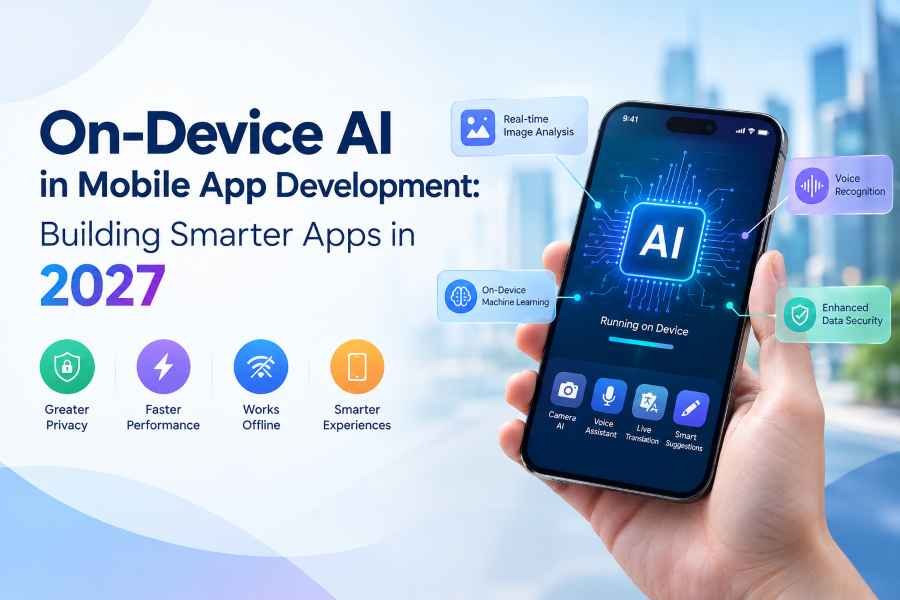
Applications are changing fast because artificial intelligence has become a key part of digital experiences. From suggestions to smart virtual helpers AI is changing how people use mobile apps. A promising change is On-Device AI in Mobile App Development. On-Device AI lets artificial intelligence models work directly on smartphones and other devices of depending only on cloud servers. As companies plan for 2027 On-Device AI is a choice for making mobile apps faster smarter and more privacy‑friendly.
Traditional cloud‑based AI sends data to servers for processing. On-Device AI does tasks on the device itself using the device’s processor, graphics processing unit or neural processing unit. This way response times are lower privacy is higher. Some features can work even when the internet is not available. Companies that develop Android and iOS apps can use On-Device AI to boost user engagement improve performance and provide personalized services.
What Is On-Device AI in Mobile App Development?
On-Device AI means that intelligence and machine learning models run straight on a mobile device. These models look at user inputs find patterns create responses and carry out smart tasks without needing every request to go to an external server. For example a mobile app can use On-Device AI to spot objects in photos shorten text, translate parts of text guess what a user likes or give smart help.
On-Device AI is getting more useful because new smartphones have processors and special AI hardware. Developers can use tools like Google AI Edge, LiteRT and platform‑specific machine learning frameworks to add AI features to apps. Apple’s Core AI framework also lets compatible AI models run directly on Apple devices. These tools give developers ways to build smart experiences while keeping performance, privacy and resource use in check.
In 2027 mobile app development will focus more on picking the AI setup for each app. Of sending every request to the cloud developers can decide if a task can run on the device. Simple text work, image recognition and some personalization tasks fit well with On-Device AI while complex thinking or tasks that need a lot of data may still use cloud models.
This flexible way is very helpful for companies making apps for health care, retail, education, banking, travel and customer help. For instance an education app could give study summaries made on the device while a shopping app could look at product pictures or give suggestions. What On-Device AI can do depends on the model the device’s hardware, the operating system and the resources available.
Key Benefits and Real-World Applications of On-Device AI
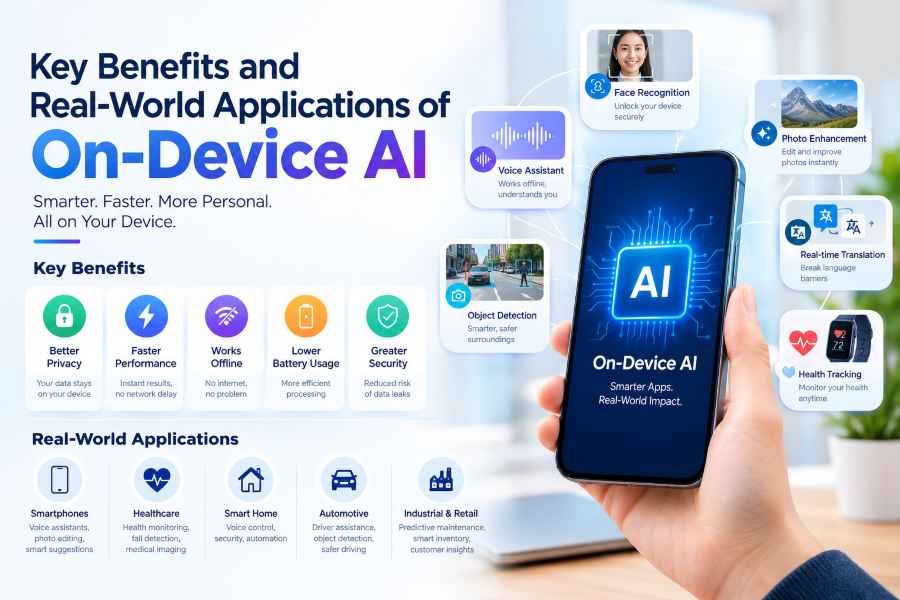
A benefit of On-Device AI in Mobile App Development is quicker response time. Because On-Device AI tasks run on the smartphone apps can skip the network delays that come from sending requests to faraway servers. This makes interactions smoother for things like picture analysis, text suggestions, voice commands and smart search. How fast On-Device AI is depends on the size of the model the device’s power and how hard the task’s
Privacy is another advantage. When data is handled on the device some personal details do not have to leave the device. This helps developers build privacy‑aware features for apps that deal with information.. On-Device AI does not automatically make an app safe. Developers still need to set up permissions encrypt stored data use secure login and follow good data‑handling rules.
On-Device AI is also useful because it works offline. Classic AI features often need an internet link but On-Device AI models can keep working when the connection is weak or missing. For example a travel app could give language help without the internet while a field‑service app could do some image recognition, in remote spots. Developers should clearly state which features work offline and which still need the internet.
Personalization gives another chance. Mobile apps can use preferences and usage patterns that’re on the device to give better recommendations, ideas and content. A fitness app could look at activity data kept on the device to suggest workouts. An e‑commerce app could make product finding easier by learning what a user likes long as the right permissions and privacy rules are followed.
On‑device AI can help businesses keep infrastructure costs down. When suitable requests are processed on the device the number of cloud inference calls goes down. Usage charges are lower. Googles LiteRT technology gives developers tools to deploy optimized machine learning models. Apple also supplies options to run compatible models on‑device. Still the total cost depends on development effort, testing, model optimization, device compatibility and ongoing maintenance.
For implementation developers must look at model size, memory usage, battery consumption, processing speed and the variety of devices that the audience uses. Quantization and other optimization techniques can lower model resource demands. They may change accuracy. Testing on devices is therefore essential to keep a consistent user experience.
How Businesses Can Prepare for Smarter Mobile Apps in 2027
Businesses planning their mobile application should start by spotting user problems that on‑device AI can truly solve. Of adding on‑device AI just because it is trending companies should focus on features that boost convenience, accessibility, speed or productivity. Examples are document scanning, offline assistance, smart search, automated content summaries, image classification and personalized recommendations.
Choosing the development approach is also important. Native Android developers can explore Googles AI ecosystem, including LiteRT and on‑device AI APIs. For iOS applications developers can evaluate Apple’s machine learning and Core AI capabilities. Cross‑platform projects need compatibility testing to see if the chosen models and frameworks work well on both Android and iOS devices.
A hybrid on‑device AI architecture can be very useful. In this approach light tasks are processed on the device while heavier tasks are handled by cloud AI services when needed. For example a mobile assistant might do text summarization locally but use a cloud model to answer questions that need a lot of information. This arrangement balances responsiveness, privacy, functionality and scalability.
Security and responsible on‑device AI practices should stay central during development. Businesses must check what information their applications collect how long it is kept and whether any data goes outside the device. Businesses should also test on‑device AI outputs for accuracy watch performance and put safeguards in place for high‑impact decisions. On‑device AI results should not be taken as correct.
Another priority is user experience. On‑device AI features should be easy to understand, accessible and optional when suitable. Applications should explain when a feature needs an internet connection, extra permissions or compatible hardware. Clear. Useful functionality help users trust and use on‑device AI features.
Working with a mobile app development company can help businesses evaluate technical needs pick suitable frameworks and build scalable applications. Nextr Technology offers digital technology services, including mobile app development, software development and website development. Businesses can look at its services to plan solutions that fit their operational goals and customer expectations.
As 2027 comes near on‑device AI offers a chance to build applications that’re faster, context‑aware and privacy‑conscious. Companies that pair the right on‑device AI models with product design and strong security practices will be better positioned to deliver useful digital experiences.
Conclusion
On‑device AI is becoming a direction in modern mobile app development because it lets AI features run directly on smartphones. Faster responses, data privacy, offline use and chances to cut cloud usage make it attractive for many business applications. Still successful implementation requires careful on‑device AI model selection, device compatibility testing, performance tuning and responsible data handling.
In 2027 businesses should focus on practical on‑device AI features that solve user problems instead of using technology for its own sake. By mixing on‑device processing with cloud AI when needed companies can build scalable applications. Partnering with a provider such as Nextr Technology can help businesses plan and build mobile applications that meet changing customer expectations.
Frequently Asked Questions (FAQs)
1. What is on-device AI in mobile app development?
On‑device AI is a technology that lets intelligence and machine learning models run directly on smartphones or other devices. It supports features such as image recognition, text summarization, smart suggestions and some offline on‑device AI functions without sending every request to a server.
2. What are the main benefits of on-device AI for apps?
The main benefits are responses, better privacy for data processed on the device offline use for compatible features and less reliance, on cloud AI services. The real benefits depend on device hardware, model efficiency and application design.
3. Can on-device AI work without an internet connection?
Yes. On-device AI models that are installed on a device can perform tasks that the device can handle without an internet connection. However any feature that needs data from the web, a cloud‑based model, a remote database or an external API will still require a network connection.
4. Which technologies can developers use to implement on-device AI?
Developers can explore Google AI Edge, LiteRT, Android AI APIs and Apple on-device AI frameworks. The best option depends on the target platform the on-device AI use case, the model requirements and device compatibility.
5. How can a mobile app development company help businesses adopt on-device AI?
A mobile app development company can identify the on-device AI use cases, select compatible technologies, fine‑tune models, test application performance and implement security measures. These services help businesses build, on-device AI applications that balance functionality, privacy, usability and scalability.
Thank you for reading
Buy Latest Tech Gadgets and Laptops: Click Here
Buy Web Hosting at an affordable price: Buy Now.
If you want to build your website at an affordable price, contact www.nextrtechnology.com
If you want to build your website at an affordable price, contact www.nextrtechnology.com
Read more blogs: https://nextrtechnology.com/blog/